
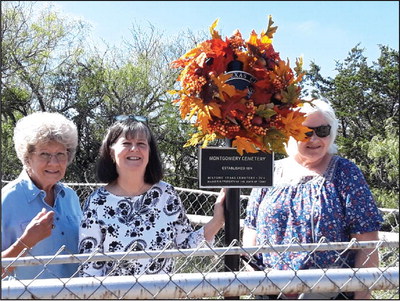
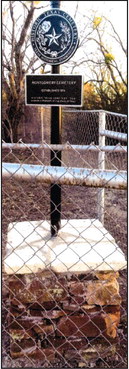

The Montgomery Cemetery Association met on September 24, 2022, at 11:00 in the morning at the site of the cemetery located about 2 1/2 miles north of Cherokee, Texas, to dedicate the placement of the Texas Historical Marker. It was a beautiful day to remember those who had gone on before as well as those in particular who were laid to rest in the Montgomery Cemetery. President Janet Root, Historian Betty Fowler and Secretary/Treasurer Barbara Maddox were in charge of the program.
After the invocation, President Janet root presented the history of the Montgomery cemetery as researched and prepared by Goldie Conley (now deceased) for the original dedication of the cemetery April 1995. It is as follows: Dedication of the Montgomery Cemetery San Saba County, Texas April 1995 As most of us are aware, the biggest influx of settlers to this part of San Saba County occurred during the 1870s and 1880s as people saw new opportunities away from the turbulence and destruction left by the civil war in the older states.
However, 20 or so years earlier, a few hearty souls had established new homes along Cherokee Creek. In 1847, John O. Meusebach, leader of the German immigration movement to Texas, had met with the Comanche Indians on the San Saba River and signed a treaty which helped open this part of the new state of Texas to settlement. Families such as the Woodwards, Akes, Cavnesses, Kuykendalls, Grays, and others settled here, beginning in the early 1850s. Among these early pioneers were several families from Kentucky and Arkansas, including the J. J. Montgomerys, with their sons, Joseph N., John Calvin, and Martin Luther, and their daughter Abigail (Mrs. Elijah Estep), and other family members of the Williams family who were related to the Montgomerys by marriage, four Williams girls having married Montgomery men.
These families played an important part in the development of the Cherokee area. San Saba County was formed in 1856, and John Williams was among those who signed the original petition to the state legislature requesting this. The first county election was held May 3rd of that year, and John Calvin Montgomery was elected one of the first county commissioners. Among the first road reviewers, from San Saba to Cherokee, appointed in November 1858, where John C. Montgomery, Joe Montgomery, and John Robert Williams. In 1858, W. J. Montgomery was elected County Surveyor and also appointed to serve on the first board of school examiners. According to Alice Gray Upchurch's writings, there was also a Montgomery School at one time which was situated east of Highway 16 on the creek near the old grist mill. This was probably in the early 1870s, and M. M. Montgomery is listed as a trustee in old school records.
The legendary Captain Johnny Williams settled in Cherokee about 1854, and for several years he commanded a company of Texas Rangers which helped to protect this part of the frontier. John Riley Williams was appointed the first Postmaster of Cherokee Creek in 1858, and Elizabeth Williams Hannahserved in this position a few years later. Her son, David Seth Hanna, laid out the present townsite of Cherokee in 1878, which superseded the three or four previous log settlements along the creek. Abigail and Elijah Estep's son, Lee, and his wife, Ella, reared their family in Cherokee. Their children were Mae Belle, Clyde, Warren, Virginia (Virgie), Joe, Mintie, Robert, Olive, Madye, and Emogene. Descendants of this family continue to contribute to the betterment of Cherokee today. Several still live here and are active in various church, community, and school activities.
In the early 1880s, the Jasper and Nancy Crab Randolph family moved to Cherokee and apparently settled on the creek near the Montgomerys. This couple had previously lived in Huntsville, Texas, where their parents had been friends and contemporaries of Sam Houston. Hillary M. Crabb, Nancy Randolph's father, had been a judge, Texas legislator, and checker-playing buddy of Sam Houston. His checkerboard is now in the Houston Law Office on the grounds of the Museum in Huntsville. (And I just got real excited when I saw it a couple of years ago!)
In the summer of 1883, a Randolph daughter, Lucy, married Dick Montgomery. In the fall of that same year, Jasper Randolph died and was buried in the Montgomery Cemetery. Sadly, in 1899, Lucy Montgomery and her sister, Ella Randolph Long, both died while in their 30s, and were also buried there. Ella was my grandmother. Other family members were buried there in subsequent years.
I recall many stories of Nancy Crabb Randolph and her good influence. She helped care for her grandsons, Herbert and Banton, after their mother, Dora (Mrs. John Warren Randolph), died in childbirth in 1880, when Herbert was only two years old. She nursed her daughter, Ella, during her illness with tuberculosis, as well as helping care for Ella's young children after her untimely death. She was a good neighbor to many. She was, if not a charter member, at least an early day member of the Cherokee Church of Christ. She was born in the eastern part of the Mexican state of Texas in 1832 and was buried in the Montgomery Cemetery in Cherokee in 1906.
In 1897, John Warren Randolph, (Jasper and Nancy's son), married Ann Miller and they were the parents of Hettye, Rhoda, Warren, Alva, Charles, Ellis, Uriel, Neal, Irene, and Tom Ball Randolph. Randolph descendants also continue to contribute to the betterment of the Cherokee area.
Official death records for this part of the frontier were incomplete or non-existent in the 19th century; many times neighbors performed the chores necessary for burials; as many of the graves in the Montgomery Cemetery are unmarked, or marked only with native rocks, we will never know who all is resting in the scenic setting, or just when the first burial occurred. Indications are that William D. Montgomery was an early day owner of the land which contains the cemetery, and one story which has been handed down is that a cowboy was the first to be buried there. The earliest marked death date is that of W. D. Montgomery, who died in August of 1874, but is likely that some graves predate this. In addition to those I previously mentioned, other marked graves are those of Mintie Estep, Maud Wood, Myrtle Wood, Madison York, Nanny York, J. D. Anderson, Archie Long, and John J. Long. It is thought that M. L. Montgomery is also buried there.
A few years ago I counted about 55 graves, many of which were of children. However, there are probably more considering the ravages of time to the plot. In 1919, Ned Montgomery, whose grave has just recently been marked, was buried in the cemetery, and apparently the site has not been used for burial since then. [Robert (Bobby) Denton was buried in the Montgomery Cemetery after his death on June 17th, 2003.] Nevertheless, at one time all the people buried there were residents of Cherokee, and we respect their memory and believe that their earthly remains deserve a well-marked and maintained final resting place. This has been our goal throughout this restoration project. We salute the memory of these early pioneers whose labors helped ease the paths for those of us who followed them.
May they rest in peace! Compiled by Goldie Smith Conley, 1995 Betty Fowler, who was very instrumental in getting the Texas Historical Cemetery Designation approved May 27, 2016, and then on to receive the Texas Historical Marker on August 27, 2020, gave a Historical Summary bringing it up to date as follows: Montgomery Cemetery Historical Summary September 24, 2022 By Betty Fowler The cemetery was named for the J. J. Montgomery family who settled along the upper Cherokee Creek in the 1850s. Old maps and records showed W. D. Montgomery was the original land holder. It is probable there were burials prior to 1874, but no records
See Montomgery Cemetery remain and most of the graves were marked with native limestone rocks without lasting inscriptions. It is estimated that the remains of at least 60 people who once called Cherokee home, now lie in this rustic hilltop. When a survey of the cemetery was made in 1970, there were over 50 recognizable graves. A dowser found evidence of graves scattered down the sloping hillside, but only 16 historic marked graves have names inside on the markers today. Surnames of those known to have been buried here are Anderson, Crabb, Estep, Long, Montgomery, Randolph, Wood, and York. We also honor the memory of those whose final resting places and names are no longer visible in this fenced in area designated as a Texas Historical Cemetery and others who are laid to rest along the sloping hillside.
This cemetery was unused and neglected for almost 80 years. However, in the 1993 efforts were made to restore and preserve the Montgomery Cemetery. The Perry family, who owned the land, was gracious enough to allow us to proceed with the restoration. Many interested individuals donated time and money to this effort. Committee members included my Aunt Goldie Conley and Floyce Slaughter, along with Tom Bowden, Sue Rhoades, Wayland Perry, Marvin Foster, Charles Randolph, Nelda Weatherby, Jean Lynn, Leroy Slaughter, and Bill Williams.
In 1994 this enclosure fence was erected around what remains of the cemetery, but not the sloping hillside which at one time had visible graves. At this time a Montgomery Cemetery sign was placed over the entrance gate by Wayland Perry and a crew of workers.
I treasure my memories of Aunt Goldie telling me about it and that at one time graves were scattered down the hillside. While speaking at the dedication ceremony on April 25, 1995, she said, “ a few years ago I counted about 55 graves, many of which were children. However, there are probably more, considering the ravages of time. “
Because of my interest in genealogy and preserving records and cemeteries, and Aunt Goldie making me aware of the Montgomery Cemetery, a page was created on the <findagrave.com> website with a brief description of the cemetery. I photographed the cemetery and added photos of the remaining markers in 2008.
After attending a workshop about obtaining a Texas Historical Cemetery designation, I started the necessary paperwork. At a meeting with the San Saba Historical Commission in October 2013, I learned that Sam Burnham had surveyed many cemeteries and those records were kept at the Rylander Library. I was able to obtain a copy of the plot map he had done of the Montgomery Cemetery to submit with the required photographs. Without the detailed survey and records, the task would have been much more difficult.
A certificate designating the Montgomery Cemetery as a Texas Historical Cemetery was issued May 27, 2016. This was helpful in applying for the Texas Historical Marker we are here to dedicate today, but it required another set of paperwork to obtain the marker. The paperwork can be submitted only at a certain time each year and only a limited number of markers are approved each year. The Montgomery Cemetery Association wholeheartedly agree to provide the funds for the marker and to finish submitting the application. I would like to thank Barbara Maddox and Jan Root for all they’ve done to make this happen. The marker was approved in 2018 and received August 27, 2020. It was put in place by Ricky Maddox in 2021. Brett White, a stone mason, created the artistic rock foundation. We so appreciate the beautiful job he did, making it look like an integral part of the cemetery that has been here so long.
The goal throughout the restoration process that began in 1993 was to provide a well-marked and maintained resting place. Thanks to the efforts of many, this area is fenced and has its name above the entrance. Now there is a roadside sign on Highway 16 with an arrow pointing the direction to the Montgomery Cemetery. Detailed information about the cemetery is documented and saved at the Rylander Library. Photos of the grave markers and information about the cemetery are on <findagrave. com>. Texas Historic Cemetery Designation has been obtained, and this Historic Texas Marker has been placed. May those buried here rest in place.
Gratitude was expressed to everyone who had shown an interest in the cemetery by whatever means.
A wreath was hung on the marker and the group sang “God bless America.”