
By Courtenay Smith, Executive Director
Texas Botanical Gardens & Native American Interpretative Center, Inc.
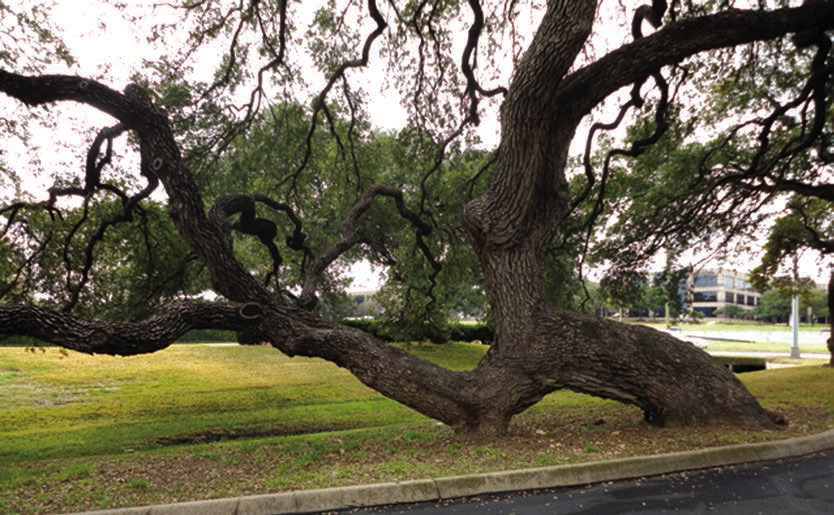

The Texas Botanical Gardens & Native American Interpretive Center, Inc. is pleased to collaborate with the Mills County Historical Museum at Goldthwaite and the Penatuhkah Comanche Trails Partnership in presenting a lecture on Comanche Marker Trees of Texas by anthropologist Linda Pelon. The event will take place at 4:00 p.m., Thursday, July 10, 2025, at the Mills County Historical Museum at Goldthwaite, 1119 Fisher St., Goldthwaite, Texas 76844.
Long before settlers began moving westward, the land we now call Texas was home to thriving Native American communities. These early inhabitants developed remarkable methods of communication to share vital information across great distances— using smoke signals, pictographs, petroglyphs, and even specially shaped trees known as marker trees.
The Penatuhkah Comanche Trail initiative highlights several key sites tied to the history and movement of the Comanche people through Central Texas. Here in Mills County, both the Texas Botanical Gardens & Native American Interpretive Center, Inc., and the Mills County Historical Museum at Goldthwaite have contributed to preserving and honoring this important legacy.
Linda Pelon has spent over three decades researching Comanche history and land use in Texas. Her 1993 master’s thesis focused on the Penatuhkah Comanche, and she continued this work while in the Transatlantic History PhD program at UTA. After years as an anthropology professor at McLennan Community College in Waco, she returned full-time to Comanche research and helped establish the Penatuhkah Comanche Trails Partnership, where she now serves as Project Developer working closely with the Comanche Nation to support their return to ancestral lands in Texas.
In her book Comanche Marker Trees of Texas—coauthored with Steve Houser and Jimmy W. Arterberry and published by Texas A&M University Press—Linda Pelon explains that although true marker trees are rare, a remarkable number still survive in areas once frequently used by the Comanches. Given the deep Native American history in our region, it’s very possible that undiscovered marker trees or smoke signaling sites remain hidden in Mills County today.
“If you suspect that your property may contain one of these culturally significant features, we encourage you to reach out to Linda Pelon at the event or to us at the Texas Botanical Gardens & Native American Interpretive Center,” says Executive Director Courtenay Smith. “We’d be honored to help uncover and preserve this vital piece of Texas history.”
This event is free to TBG&NAIC and Museum members, $5.00 for nonmembers, and open to the public. Seating will be available on a first-come, first-served basis.
Following the presentation, Linda Pelon will be available to sign copies of her books Comanche Marker Trees of Texas and Texas Comanche Land Revisited, available for purchase at $35 and $30 respectively. Guests are also encouraged to explore the Museum’s educational exhibits, many of which showcase the lifeways of the First Peoples of Texas.
This event is presented in collaboration with the Mills County Historical Museum and Penatuhkah Comanche Trails Partnership.