
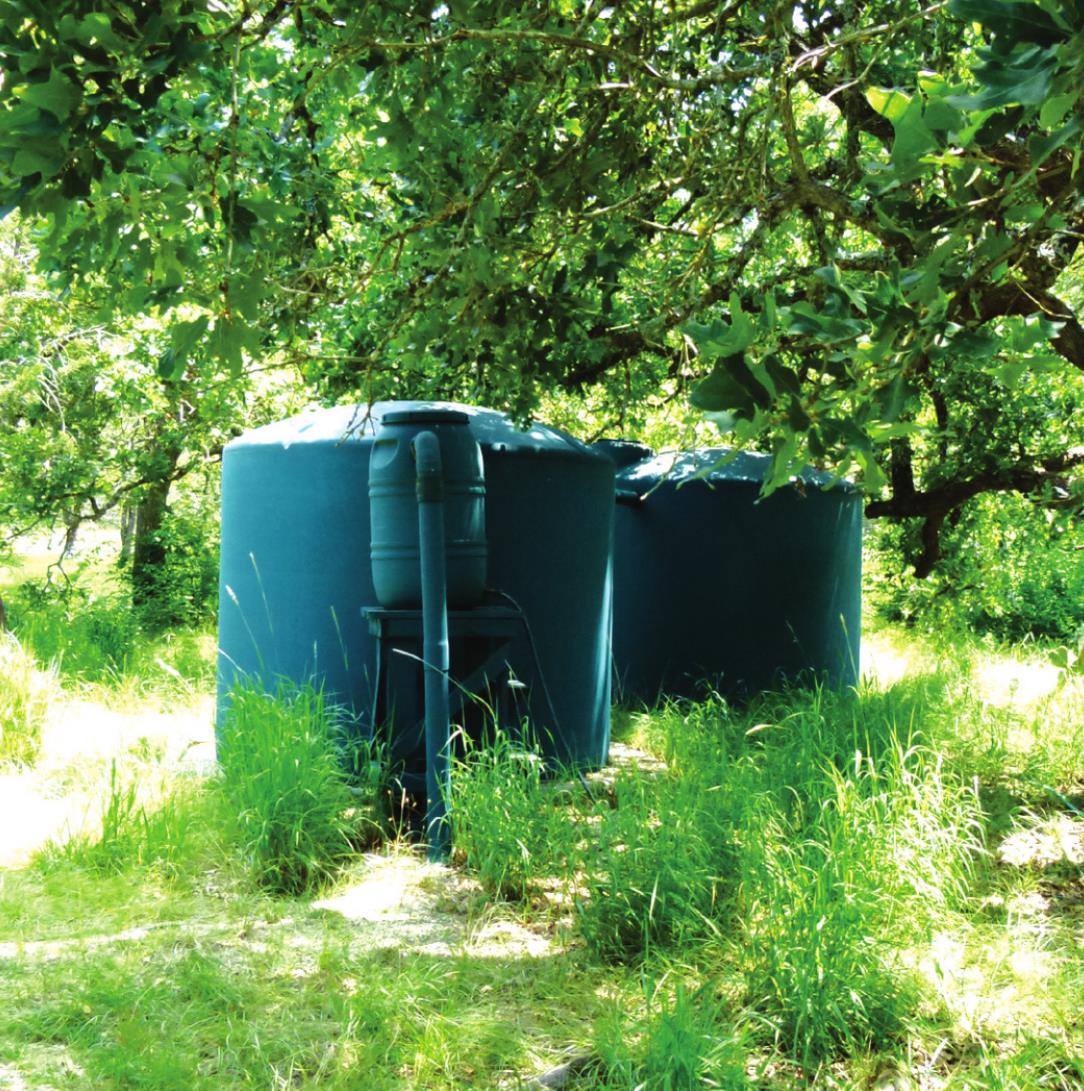

I doubt that there are many Hill Country residents that are not aware that the future of our water supply is uncertain at best. It is not at all clear that governments and water-supply companies will be able in the future to find enough water for even the current population, let alone the projected increase in the population. I expect that it is highly likely that some form of water restrictions or regulations will become much more common and severe as time goes by.
There might not be much that individuals can do about any of the above, but there are some things individuals can do to take matters in their own hands. Individuals can choose to use less water for landscapes, especially waterhungry non-native lawns, as well as to conserve water in many other ways. But harvesting rainwater is something many landowners can do that is a benefit to the landowners themselves as well as to society as a whole.
Among the reasons for harvesting rainwater are:
• To avoid drilling a well.
• Current water source is unreliable or of poor quality.
• To have purer, soft water free of chemicals, pesticides and hormones.
• To be able to water plants during water restrictions.
• To not use more than your fair share of a scarce resource.
So what is required to harvest rainwater? In its simplest form, what is needed are gutters on your roof, downspouts from the gutters to a tank of some kind, and a faucet near the bottom of the tank. Such a system will capture and store rainwater that you can use to run a hose or drip tubing to flowerbeds or vegetable gardens.
In a more complicated system that can furnish all your water needs inside the house including drinking, cooking and bathing, you still need the gutters and downspouts, piping to carry the water to larger storage tanks, several filters of various kinds, a pump to pump the water to all the places in your house, and a UV sterilizer to make the water safe for drinking.
And there are all kinds of systems in between these two extremes. The Internet contains lots of information, books, drawings, and advice. You can view an actual working system by visiting Riverside Nature Center.
What kinds of materials are used? While metal roofs are preferred, composition asphalt shingles are acceptable. Most all piping is inexpensive PVC pipe which is one of the materials now used in new construction. Storage tanks are either plastic (polyethylene—the same as is used in milk bottles and gallon water jugs), fiberglass or, for larger tanks, a metal shell with a rubber liner. All other components are as used for regular water systems. One thing to know: There are expensive systems, and there are cheaper systems. The former may have more bells and whistles than cheaper systems, but they both capture the same amount of water.
How much water can you capture? It depends on the size of your roof. One thousand square feet of roof area will capture 600 gallons of water in a one-inch rain. A typical 2,000 square foot house is likely to have at least 2,300 square feet of roof footprint, so a one inch rain will capture almost 1,400 gallons of water in a one inch rain. Even in a less than “average” rainfall year of 25 inches, that is a total of 35,000 gallons, or nearly 100 gallons a day!
One point should be made because it is a common question. If everyone captured rainwater, won’t the river dry up? The answer is no for several reasons. First, even if most people captured rainwater, the area of roofs even in the city is a small fraction of the total land area. Furthermore, we USE water, we do not DESTROY it. Currently, the city takes water from the river or the aquifers, and you use it in your house or on your lawn.
The water used outside either soaks into the ground and flows downhill toward the river or evaporates from the ground or vegetation. The water you use inside goes to the sewer system, is treated, and then either used on golf courses or is returned to the river. When you capture rainwater, you are just holding it for a time, but you are using it in the same way as city water, so its fate is the same as city water, except that the storm water amounts are reduced, thus lessening the effects of floods.
It’s not magic. It works. Many of us are doing it.
Until next time…
Jim Stanley is a Texas Master Naturalist and the author of the books “Hill Country Ecology,” “Hill Country Landowner’s Guide” and “A Beginner’s Handbook for Rural Texas Landowners.” He can be reached at <jstmn@ktc.com>. Previous columns can be seen at <www. hillcountrynaturalist.org>, or at Riverside Nature Center at <https://riversidenaturecenter.org/ past-blogs-from-a-friend/>.