
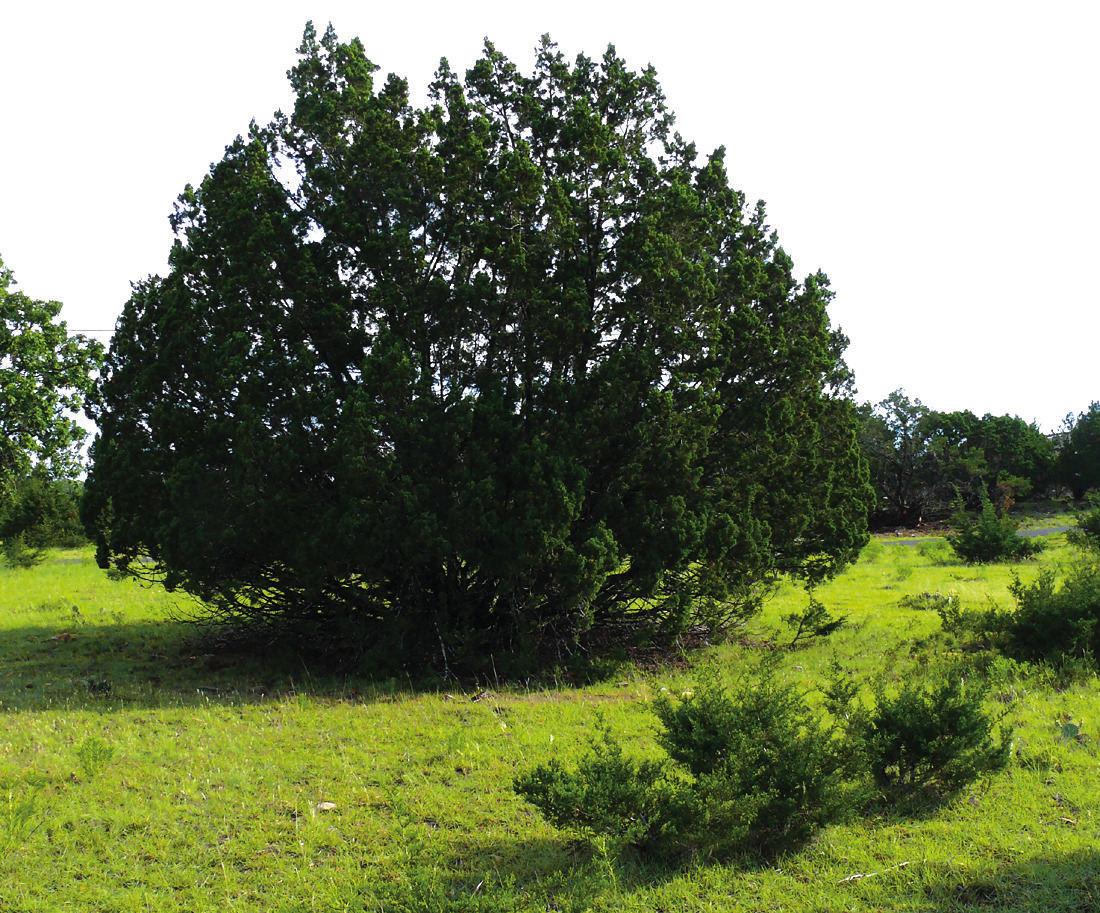
There is probably no topic of land management in the Hill Country that is so much discussed, and about which there are so many myths as cedar (Juniperus ashei, Ashe juniper, actually). Let me first try to dispel the myths.
You will sometimes hear someone assert that cedar is not native to the Hill Country. In fact, there are dozens, if not hundreds, of writings from the 18th and early 19th centuries that discuss cedar being here before anyone could have introduced it to the area.
One sometimes hears that cedar intercepts and/or uses huge quantities of rainfall. This is not so much a myth as an exaggeration. Cedars, being larger than grasses, do intercept somewhat more rainfall than grasses, so replacing some cedar with grasses may increase the amount of rainfall that soaks into the ground.
While it is true that some people have found springs returning to their land after removal of a lot of cedar, it does not mean that it works everywhere. Whether new springs are created depends on what replaces the cedar, the topography, and the underlying geology.
What is undoubtedly true is that Ashe juniper is more pervasive in the Hill Country now than it was 150 or more years ago. The conditions that prevented it from becoming more prevalent back in those days were periodic fires and the generally greater amounts of grass back then. Occasional fires sweeping through dry tall grass would have killed any small cedar bushes, as well as many small hardwoods, thus maintaining a more open grassland.
As the human population and the livestock numbers increased, fires were suppressed and were less intense, so woody plants began to encroach into areas that were once mainly grasslands. Hardwoods tend to grow slower than cedar, and because young hardwood sprouts are a favorite food of deer, the increasing deer population limits hardwood expansion. But deer don’t eat much cedar, so nothing is left to control its expansion.
At the Kerr Wildlife Management Area near Hunt, a 96-acre savanna was high fenced with no animals inside the fence in the 1960s. Today, there is virtually no grass, and the area is a total cedar brake (dense stand of cedar). There is now no natural limit to the increase of cedar in the Hill Country. Any property where the cedar is left unmanaged, will eventually become a cedar brake.
Cedar does have some positive attributes. It is evergreen, quite xeric, generally pest free and grows in any soil and very little of it at that. Its berries are eaten by many birds and small animals, and it provides cover and winter protection for birds, deer and other creatures. But large dense stands of cedar are poor habitat for anything.
Since there is no natural limit to the expansion of cedar, any bushes on a property now will continue to get bigger and most small cedar bushes will continue to grow, unless the owner conducts some kind of management program.
Fortunately, of all of the plant species that can become invasive, blueberry cedar is the easiest to kill, because it does not resprout from the roots. Once cut off below the lowest green leaf, it will die, and if the trunk is sufficiently burned, it will die. Most other species people want to get rid of will sprout back from the roots.
After weighing the options, just about everyone resorts to some form of mechanical control, including bulldozers, skid-loaders with shears, or chain saws. The first can be the most destructive to the land, the next less so and chain saws much less destructive. Most folks seem to be opting for chain saws for smaller properties and bobcats with shears for larger acreages.
Aside from the disruption of the land, the other two potential problems are to prevent erosion and what to do with the cut cedar. Most experts recommend never attempting to remove Ashe juniper from steep slopes as this almost always results in severe erosion. Laying cut branches over bare ground areas helps prevent erosion on flatter areas and helps grasses become established.
Most people resort to burning brush piles when Burn Bans are lifted and there are times of low wind and light rain or high humidity, but it is also true that many wildfires are started by people burning brush piles. So, be very careful. For smaller properties, the cut limbs can be chipped into cedar mulch.
There are six species of cedar in Texas, but the only species other than ashe juniper in the Hill Country is Redberry which, as the name implies, has red berries and is mostly found north of here.
Until next time… Jim Stanley is a Texas Master Naturalist and the author of the books “Hill Country Ecology,” “Hill Country Landowner’s Guide” and “A Beginner’s Handbook for Rural Texas Landowners.” He can be reached at <jstmn@ktc.com>. Previous columns can be seen at <www. hillcountrynaturalist.org>, or at Riverside Nature Center at <https://riversidenaturecenter. org/past-blogs-from-a-friend/>.