

Native, Evergreen Shrubs of the Hill Country
I want to discuss some of the many native Hill Country shrubs. There are far too many to fit into one column, so I thought I would discuss just the evergreen ones today. Most shrubs are multi-trunked although some can appear to be single-trunked small trees.
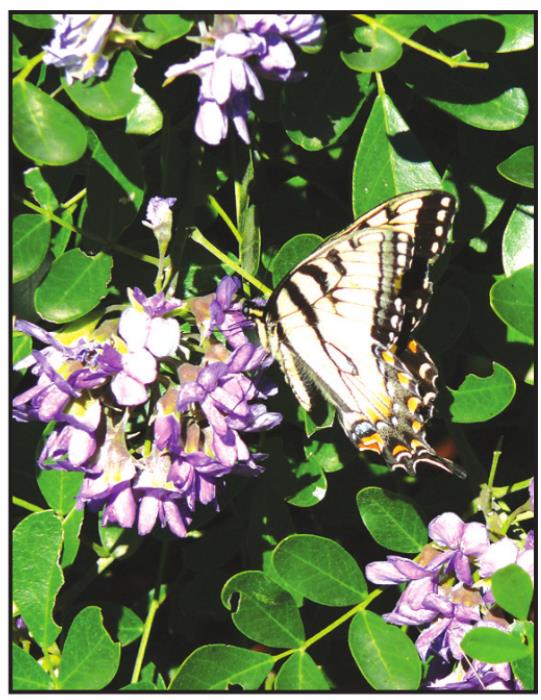
Texas Mountain Laurel (Sophora secundiflora), also called Mescal Bean, is an evergreen shrub usually 4 to 8’ tall with compound, dark-green leaves with shiny leaflets 1 to 2” long. (A compound leaf is a leaf divided into two or more leaflets with each leaflet resembling a small simple leaf.) It has large showy purplish flowers in the early spring that smell like grape Kool-Aid. It produces a gray seed pod with red seeds which ripen in late summer. Both the leaves and the seeds contain an alkaloid that is toxic to livestock and humans when ingested. Deer will avoid this plant.
Cenizo, or Texas Sage (Leucophyllum frutescens) is a 4 to 10’ shrub with very small silver-grey leaves. It usually flowers around seven to 10 days after a good rain, covering the whole shrub with lavender blooms that attract hoards of native bees. More common west of here, they require little if any extra water. Cenizo is not a deer favorite.
Evergreen Sumac (Rhus virens), is another plant with shiny green compound leaves. It produces tiny white blooms in clusters in the summer, especially after good rains. It can attain a height up to 12’, but may have leaves down to the ground. It may not be eaten by deer.
Agarita (Berberis trifoliata) is a common Hill Country shrub with compound leaves consisting of three very stiff leaflets, each with three to five very sharp points. They produce small, fragrant, yellow flowers in early spring that are a favorite with native bees. The red berries ripen in late spring and some people make jelly from them. Agarita shrubs make good “nursery plants” by keeping browsers away with their sharp leaves, thus allowing young hardwood trees to grow up inside the shrubs without being eaten. It is common to find hackberry and Spanish oak trees growing up inside an agarita. Mature leaves are not eaten by deer.
Texas madrone (Arbutus xalapensis) is the distinctive shrub or small tree with the peeling bark revealing a smooth reddish or tan bark. Its leaves are dark green and leathery, its flowers are white clusters in early spring followed by small red berries. It’s native range in the Hill Country is limited to Real, Bandera, Kendall and parts of adjacent counties. It can be very difficult to grow. In Big Bend’s Chisos mountains, there are places where madrones grow into large spectacular trees. Because of deer browsing, one usually only finds small madrones growing up inside cedar bushes or other protective vegetation.
Cedar, Blueberry Juniper or Ashe Juniper, (Juniperus ashei) is certainly the most common evergreen shrub in the Hill Country. It is dioecious, which means male and female flowers are produced on separate plants. The female plants bear the blue berry-like cones which are eaten by many species of wildlife. Cedar is eaten by deer only when there is little else for them to eat. Many species of wildlife use cedar thickets for cover, especially in winter.
There are two common Hill Country shrubs that are not strictly speaking evergreen, but are classified as having persistent leaves, meaning they survive into the winter, and in mild winters or in slightly more southern locations, may indeed be evergreen. They are the Texas Persimmon and Willow Baccharis.
Texas Persimmon (Diospyros texana) is a common shrub of central, south and west Texas. It is characterized by peeling bark, small, velvety soft leaves that curl under slightly and one-inch round persimmons. The green fruit turns black when ripe. The fruits are a huge favorite with most all wildlife and many humans as well. Texas persimmons are also dioecious. Leaves are usually not eaten by deer, but the fruit is a favorite.
Poverty Weed, Roosevelt Weed or Willow Baccharis (Baccharis neglecta) is a common, somewhat-invasive multitrunked shrub with airy fine foliage. It is commonly seen colonizing disturbed areas of bare soil and can become an invasive pest, but along riparian areas it can be beneficial in holding soil in place. Baccharis is also dioecious, and the female plant should be flowering soon with large bunches of whitish flowers. It is not eaten by deer.
Until Next Time
Jim Stanley is a Texas Master Naturalist and the author of the books “Hill Country Ecology,” “Hill Country Landowner’s Guide” and “A Beginner’s Handbook for Rural Texas Landowners.” He can be reached at <jstmn@ktc.com>. Previous columns can be seen at <www.hillcountrynaturalist.org>, or at Riverside Nature Center at <https://riversidenaturecenter.org/past-blogs-from-a-friend/>.