
More information on the 2-14-2024 article entitled: US Supreme Court considers Texas Takings Case
Lawsuits
The Plaintiffs brought takings lawsuits under both the Texas and United States Constitutions in Texas state court. Texas removed the cases to federal court where they were consolidated into one case. Texas then filed a motion to dismiss claiming that the Plaintiffs were not entitled to sue directly under the Fifth Amendment. Instead, Texas argued, a takings claim could only be made based upon a statutory provision, 42 U.S.C. Section 1983, under which Texas cannot be sued. Thus, Texas claimed that the landowners had no way to sue the state for a taking under the US Constitution.
A federal magistrate judge recommended that Texas’ Motion to Dismiss be denied. He said that this type of logic by the State would allow states to take private property and leave property owners with no federal constitutional remedy. This would, he said, “eviscerate hundreds of years of Constitutional law in one fell swoop.” The District Court adopted the magistrate’s report and recommendation and denied the Motion to Dismiss.
Texas sought an immediate appeal of that order and the question of whether property owners may sue under the Fifth Amendment without invoking Section 1983.
The United States Court of Appeals for the Fifth Circuit reversed in a one paragraph opinion, holding that the Fifth Amendment does not provide a right of action for takings claims against a state. See 53 F.4th 904. The Plaintiffs sought a rehearing, which was denied, and several opinions were issued. See 63 F.4th 416. Judge Higginbotham wrote that federal courts lack jurisdiction to hear takings claims absent a claim under Section 1983. Judge Higginson wrote that only the legislature, by statue, can create a cause of action against the State, and since that did not occur here, the case should be dismissed. Judge Higginson said that “implying constitutional causes of action is a disfavored judicial activity” and that courts should not undertake this type of activity “if there is any reason to think that Congress might be better equipped to create a damages remedy.” Judge Oldham dissented, writing that he believes that history shows the Fifth Amendment to be “self-executing” allowing claims for compensation without need for a statutory claim.
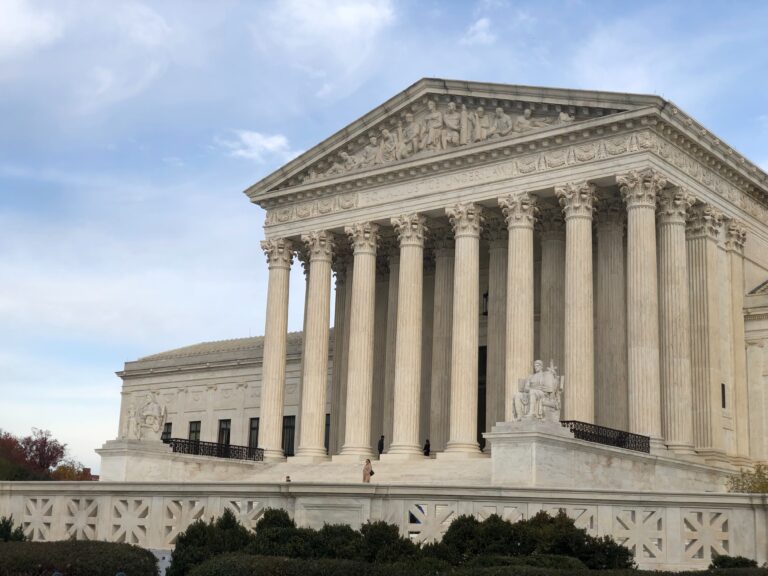
The Plaintiffs sought review by the United States Supreme Court. The Petition for Certiorari was granted on the following question presented: “May a person whose property is taken without compensation seek redress under the self-executing Takings Clause even if the legislature has not affirmatively provided them with a cause of action?” Oral argument was held on January 16.
Plaintiffs’ Arguments
The Plaintiffs filed a brief on the merits setting forth their arguments.
First, the Plaintiffs claimed that the United States Supreme Court has already answered the question presented in 1987 when it ruled on First English Evangelical Church v. County of Los Angeles. The Plaintiffs read that Opinion as holding that suits for compensation do not need a statutory basis because they are “founded upon the Constitution of the United States itself.”
They also claimed that text, history, and tradition support this result. The text of Fifth Amendment, they argue, does not require a statutory basis to receive compensation. They traced the tradition of such compensation back to the Magna Carta in 1215. They also pointed to the history of cases going back to the 1800’s allowing such claims.
Finally, the Plaintiffs also stated that the real issue here is whether federal courts can enforce the federal constitution, and the answer is “yes.”
Texas’ Arguments
The State of Texas filed a response brief beginning with the statement, “The state of Texas takes property rights extremely seriously” and notes that the Texas Constitution is more protective of property owners than the United States Constitution. This case, Texas claimed, is not about property rights, but about separation of powers.
Texas argued that while the Plaintiffs can (and did) sue under a state cause of action, there is no federal cause of action absent a statutory basis. Thus, property owners are not without remedy, that remedy is just at the state level. “Petitioners are correct that the question is easy: Unless and until Congress creates a federal cause of action for takings claims against the States, no such federal cause of action exists.” Texas did not dispute that the Plaintiffs are entitled to compensation if their property has been taken (an issue that has not yet been litigated in this case).
Texas argued that the Takings Clause simply does not create a federal cause of action. Further, they claimed that the Plaintiffs’ arguments and cases conflate the issue of the right to compensation–which no one disputes–with the “procedural mechanisms to vindicate those rights.” The State also argued that historical practice indicates that there is no such cause of action.
Finally, Texas argued that the Plaintiffs’ arguments misstate Texas’ position, misinterpret the Constitution, and misunderstand both history and precedent.