
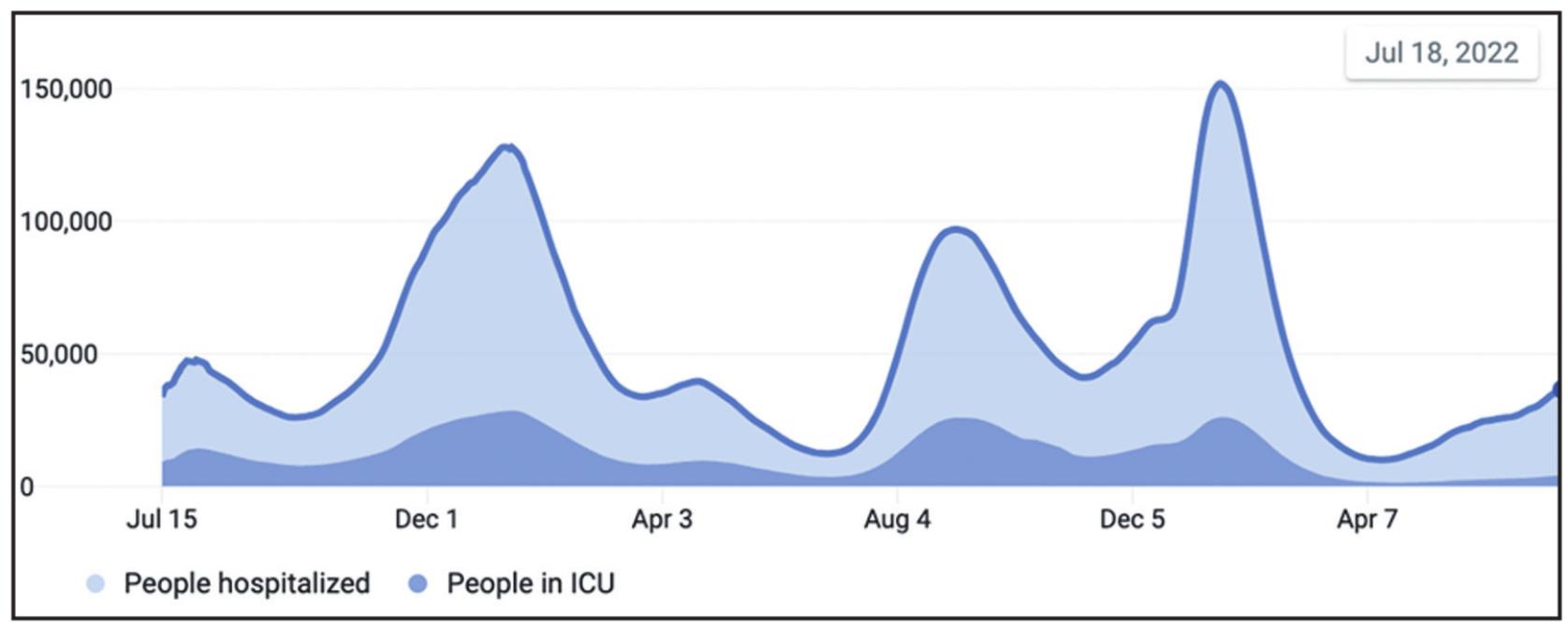
Sadly, COVID is still very much with us and not likely to leave. Since the Omicron variant first appeared over a year ago, it has morphed into several “subvariants” with the ones numbered 4 and 5 causing most of the infections right now. As a picture of how COVID has progressed over the past two years, the image shows the number of people hospitalized (light blue) and the number in the ICU (darker blue) as it changed over time since July 2000 (data from https://ourworldindata.org). Reports from the health department on number of cases is misleading now that many people are doing home tests and their results are not reported to the health department. At the BSW clinic in town, we are seeing multiple positive tests daily.
There appears to be a pattern of a COVID surge in summer and again in winter in the US. The number of cases is rapidly rising right now due to the highly contagious BA-5 variant. And, while it generally causes a milder infection, the graph demonstrates that it can make people very sick – especially those more vulnerable due to age or condition. ICU beds in our region are 80-90% filled with COVID patients right now which leaves us vulnerable to another shortage of space to treat those most critically ill.
To help prevent another large wave of COVID, we should follow the recommendations on ISOLATION (separating from others while sick or recovering from COVID) or QUARANTINE (separating from others after significant exposure though not ill).
Here is a review of the recommendations for isolation and quarantine:
If you've TESTED POSITIVE for COVID-19, you need to isolate yourself (stay home, away from others):
1. IF YOU CURRENTLY HAVE OR DEVELOP SYMPTOMS: You can end isolation after 5 full days following your first symptom, with day 0 being the day your symptoms first appeared. You must be fever-free for 24 hours without the use of fever-reducing medication and your other symptoms must have improved.
2. IF YOU HAVE BEEN AND REMAIN SYMPTOM FREE: You can end isolation after 5 full days, with day 0 being the day you tested positive.
In either of the above cases, you should continue to wear a mask around others for 5 days after ending isolation.
If you have not been tested but have BEEN EXPOSED TO SOMEONE THAT HAS COVID-19, you need to quarantine yourself (stay away from others). What steps to take depend on your vaccination status:
VACCINATED: For those that have been boosted or recently vaccinated (within the last six months for Pfizer/Moderna or two months for J&J):
1. Wear a mask around others for 10 days.
2. Consider getting tested at home or clinic if:
- A) You have had no symptoms and are on Day 5, OR
- B) You develop symptoms at any point before Day 10
UNVACCINATED: For those that are unvaccinated, or received Pfizer or Moderna vaccine over six months ago and are not boosted, or received J&J over two months ago and are not boosted:
1. Stay home for 5 days. After that continue to wear a mask around others for 5 additional days.
2. If you can't quarantine you must wear a mask for 10 days.
3. Consider getting tested at home or clinic if:
- A) You have had no symptoms and are on Day 5, OR
- B) You develop symptoms at any point before Day 10