

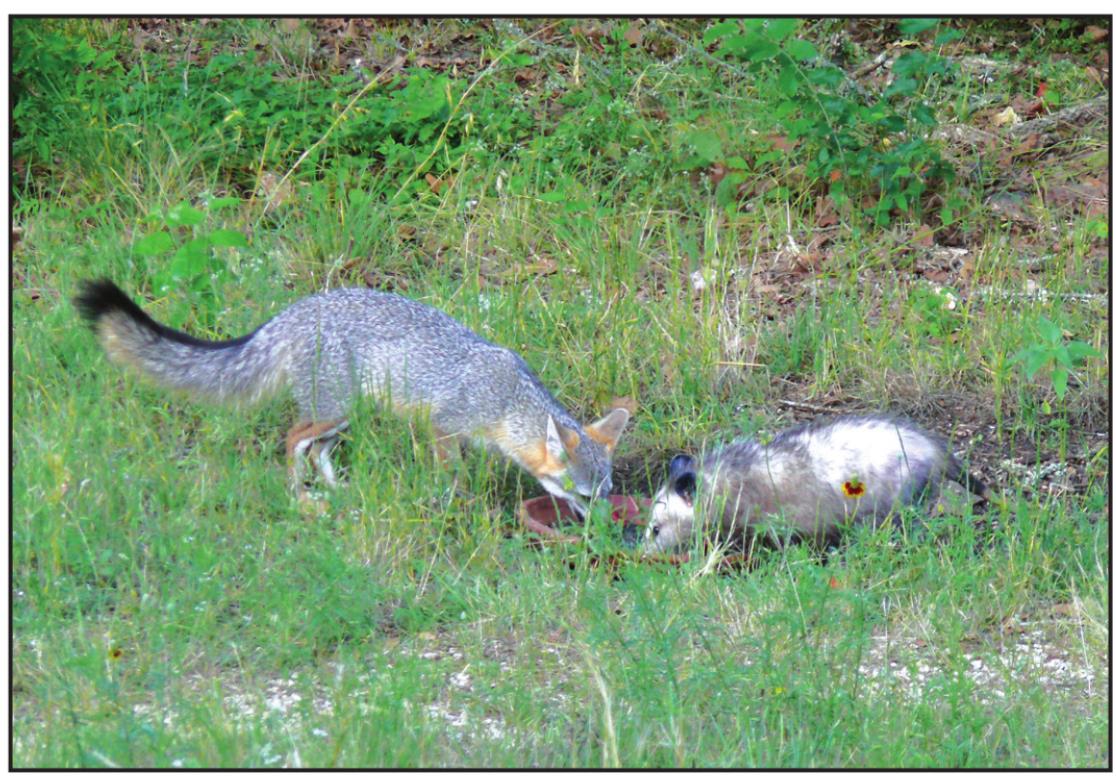
Our Hill Country Foxes
To continue our discussions of small Hill Country mammals, today I want to discuss our Hill Country foxes. There are three species of foxes in Texas. The small swift or kit fox (Vulpes velox) is an uncommon resident of the Panhandle and the Trans-Pecos. The two species that inhabit the Hill Country are the gray fox and the red fox. All foxes belong to the canine (Canidae) family.
The native Gray Fox (Urocyon cinereoargenteus) is the most common Hill Country fox. It is grayish on the back and sides and reddish on the nape, shoulders, chest and legs. It has a large bushy tail with a black stripe along the top and a black tip. Note that a gray fox has a lot of reddish coloration which has caused some folks to misidentify it—the black tail tip may be the best identifying mark. Gray foxes are about two feet long, not counting the tail, about a foot high at the shoulder and weigh on average about 10 pounds. Sometimes when people only get a glimpse of an animal, they have difficulty telling the difference between a gray fox and a coyote, the latter of which is roughly two to three times the size of the fox.
Gray foxes range throughout the state and inhabit most habitats, especially edges where woodlands meet more open areas. Most are believed to live less than five years in the wild. They den almost any place they can find, including hollow trees. They don’t generally dig a den, but may enlarge a den of a smaller animal.
They are omnivorous, preferring mice, moles and rabbits, but also eat small birds, berries, fruit, nuts, fish, insects and carrion. They are most active at night, but may be out in the early morning or late afternoon.
Pairs appear to be monogamous, and may mate for life. Breeding takes place in winter with the young, called kits, born helpless and blind with black fur in April or May. Both parents are involved in feeding the young.
A most unusual trait of gray foxes is that they can climb trees! Unlike almost all other canines, they can rotate their forearms in a way that allows them to grasp the sides of a tree trunk and have been seen as high as 20 feet off the ground. I was once on a trail ride and noticed a fox avoid the lead horse and climb up a small live oak about 15 feet tall. As I got even with the tree, I stopped and searched for the fox, which I know didn’t come down from that tree, but I could never see the little critter.
The Red Fox (Vulpes vulpes) is much less common in the Hill Country than the gray fox. It is not actually a native of Texas. It was introduced into East Texas from the eastern US in 1895 by people who liked to go fox hunting with dogs and horses like they do in England. But when they tried to hunt the gray fox, they found that it would just climb a tree and stay there, so it was not the kind of fox hunting they had in mind. Red foxes are now found over most of the state.
The red fox may be slightly larger than the gray fox, with longer legs and may weigh a little more. There is more variation in color among individual red foxes than gray foxes. Red foxes also have distinctly different winter and summer coats, but they tend to be more reddish on the sides and back with legs nearly black and a white tip on their tail.
Their favorite habitat is one of diverse vegetation with a mixture of trees, shrubs and grass. Their den may be a hollow log or under a rock, but they may dig a den and leave a mound of dirt in front of the den, which they then mark with scat. The food habits and the reproduction characteristics of the red fox are very similar to those of the gray fox. They sometimes emit high-pitched barks or yelps.
The red fox is the most widely distributed canid in the world, ranging across North America, Europe, Asia and North Africa.
The main predators of foxes are humans and domestic dogs. The main potential threat to their survival as a species is indiscriminate predator control practices.
Until next time…
Jim Stanley is a Texas Master Naturalist and the author of the books “Hill Country Ecology,” “Hill Country Landowner’s Guide” and “A Beginner’s Handbook for Rural Texas Landowners.” He can be reached at <jstmn@ktc.com>. Previous columns can be seen at <www. hillcountrynaturalist.org>, or at Riverside Nature Center at <https://riversidenaturecenter. org/past-blogs-from-a-friend/>.