
Watching Grass Grow--It’s More Interesting Than You Think
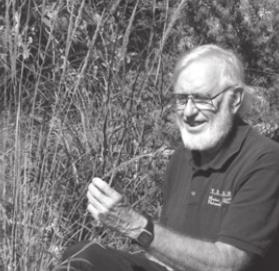

Of the over 500 species of grasses found in Texas, probably only about 75 would be considered common in the Hill Country. Grasses are classified as either “bunch” grasses or “turf” grasses; the latter being low, spreading lawn grasses. The vast majority of all native grasses in Texas, however, are bunch grasses, meaning they grow from a common base at ground level, with the leaves growing up and the roots growing down from that point.
If you could reach down and grab a bunch grass at the base and pull it totally out of the ground with all roots intact, you would see something very different from what you would see by doing that with a forb (weed or wildflower) or a small tree. Instead of a branching structure in the roots like a forb or a woody plant, all of the roots of the grass would originate at the plant base near the surface of the ground, and there would be at least as much biomass below the ground as above the ground. Mature bunch grass plants can easily have root systems 6’ or more long. Researchers proved this with the accompanying photo where a switchgrass was planted in a very tall container of soil after it was opened and the soil washed way.
Within this mass of roots lives a whole community of insects, nematodes, bacteria and fungi. About a third of these roots die every year and are replaced, and these microorganisms feed on the dying roots as well as on secretions from the living roots. In return, these microorganisms help to solubilize minerals and fix nitrogen that the roots take up. This symbiotic relationship not only helps the grass grow better, but it also makes the soil more porous and actually contributes to building more and better soil.
This porous soil acts like a sponge to allow rainwater to soak into the soil rather than run off. Native bunch grasses do a better job of this than forbs, woody plants, or for that matter, bare ground.
When one-third of the roots die each year, they are replaced by new roots made from carbohydrates that are produced by photosynthesis in the leaves. In turn, the roots bring water and nutrients from the soil up to the leaves so that the photosynthesis can take place. All of this is a long way of saying “It takes leaves to make roots, and it takes roots to make leaves.”
But what happens if Bossy comes along and wraps her long tongue around that grass plant and pulls off a lot of the leaves? The answer, like so much in biology, is “It depends.” If after Bossy has had her bite, no other animal comes along to take another bite for some time, then the stored energy in the roots and the remaining leaves can make more leaves to replace those that were eaten and the plant regains its original vigor. However, if Bossy and her sisters stay in the area and repeatedly take a bite out of our bunch grass, and if the amount of leaves they take represents 50% or more of the original bunch, there will not be enough leaves left to regrow the leaves and replace the roots that have died, and the plant will eventually decrease in size.
If this process happens repeatedly throughout the pasture, eventually all of the bunch grasses that Bossy likes to eat will decrease in number and size and may eventually die out completely, leaving mainly grasses that are either smaller, shorter or less palatable than our original grass plant. And guess what, it doesn’t take Bossy to do this to the grass; other species, including John Deere and Toro can do it, too.
The bottom line is that repeated grazing or mowing of native bunch grasses that removes 50% or more of the original foliage will eventually cause the better, more palatable grasses to decrease. They will be replaced by those species that the animals can’t or don’t like to eat or the mower can’t reach (such as grassburs), which will then increase.
On the other hand, if enough rest period between Bossy’s visits is provided, Mother Nature will be able to restore that grass plant so Bossy can enjoy another bite again in the future.
A discussion of the more common species of grasses will have to wait for a later column. Until next time…..
Jim Stanley is a Texas Master Naturalist and the author of the books “Hill Country Ecology,” “Hill Country Landowner’s Guide” and “A Beginner’s Handbook for Rural Texas Landowners.” He can be reached at <jstmn@ktc.com>. Previous columns can be seen at <www.hillcountrynaturalist.org>, or at Riverside Nature Center at <https://riversidenaturecenter.org/past-blogs-from-a-friend/>.