
Soil Testing in Three Easy Steps
(Take Care of Texas)


Why test your soil?
Getting your soil tested is like checking the oil dipstick in your car. A soil test does the same thing for your lawn.
Everyone’s soil is different. According to Dr. Tony Provin, a soil chemist with Texas A&M AgriLife Extension Service, there are 16 vital minerals that your lawn needs. Mineral levels in your soil will differ due to many factors such as your geographic location, recent weather patterns, and even the industries that operate near your home. If you’re equipped with the knowledge of exactly what your lawn needs, you can give it the fertilizer it needs to thrive.
Here are the steps you’ll take to get your soil tested:
1. Collect
Take 10 to 15 soil samples from different areas. Using a shovel or a soil probe, get a sample of soil up to 6 inches deep. A soil probe is really the
best tool to use, as it collects soil in a continuous core from the surface through the entire sampling depth with minimal disturbance of the soil. It also makes the job go faster. Detailed steps for taking samples are outlined in the Soil Sample Information Form.
Because people tend to use their front yards differently than their backyards, Dr. Provin recommends testing your front and back yards separately. Many of us spend more time in the backyard than our front yard. Oftentimes, the front yard is for aesthetics and the backyard is for playing.
The act of collecting your samples will tell you a lot about your soil. For example, if it’s difficult to get a sample, your soil is compacted. If your root depth is shallow, you’re probably mowing your lawn too short. If the soil is sticky and wet, you’re over irrigating.
Put all the samples in a clean bucket and mix well. The end result should be about one pint of soil.
2. Send
Put your collected sample in a resealable, quart-sized freezer bag or in a soil sample bag available at many Texas A&M AgriLife Extension offices and mail it along with the form.
There are multiple options for soil reports, but the basic $12 report is probably the best one for most homeowners. It gives you basic fertilizer recommendations. Here’s the form you’ll need to fill out and send with your soil sample.
3. Analyze
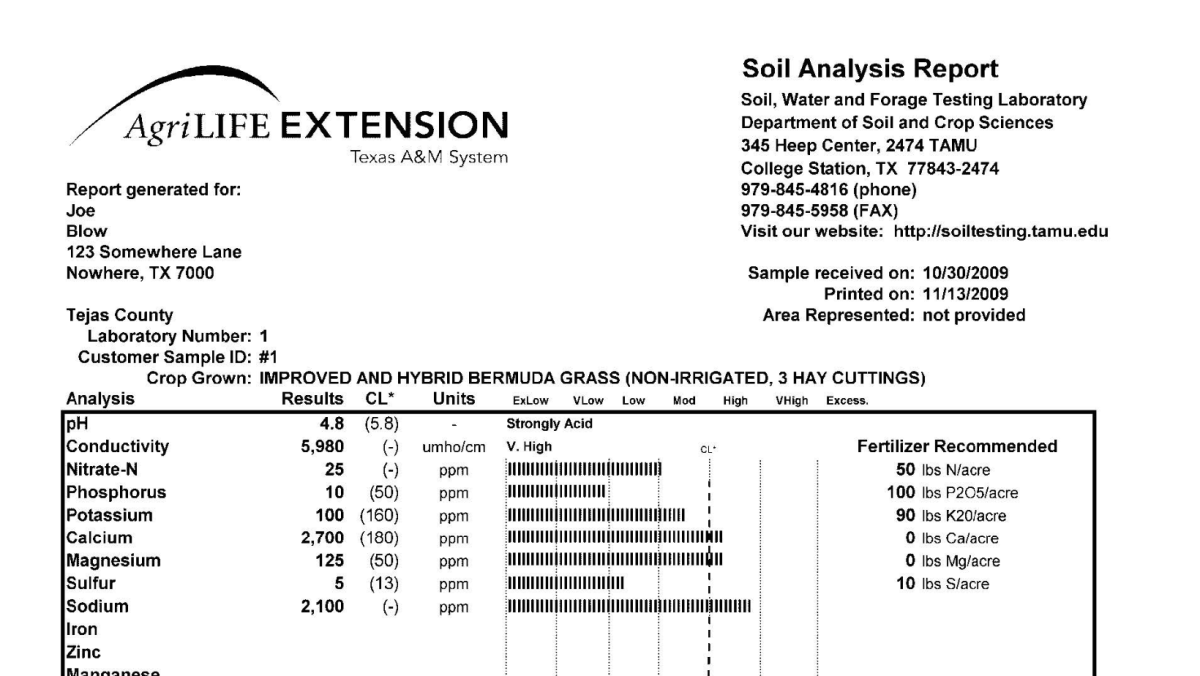
You waited about 10 days and now you’ve received your soil report! What does it say?
Your report will give you measurements on the acidity, alkalinity, salinity, nitrogen, phosphorus, potassium, calcium, magnesium, sulfur, and sodium
contents of your soil. It will also give you recommendations on soil supplements.
If you have a hard time deciphering all the science in your report, don’t worry, help is available. The Extension offices can help you read your report, determine what your lawn needs, and offer resources as well.
When it comes to fertilizer, according to Dr. Provin, there is no single, silver-bullet solution to everyone’s lawn needs. He suggests that all-in-one fertilizers are an inadequate product that may not serve you very well. A specific fertilizer tailored for your lawn is a much better option. A full-service garden center or agriculture retailer can help you locate your specific products. Again, discuss with your local Extension office the results of your test to determine the best way to supplement your lawn.
For more ideas on how to use just the right amount of resources for your lawn, read our blog about perfect irrigation.