
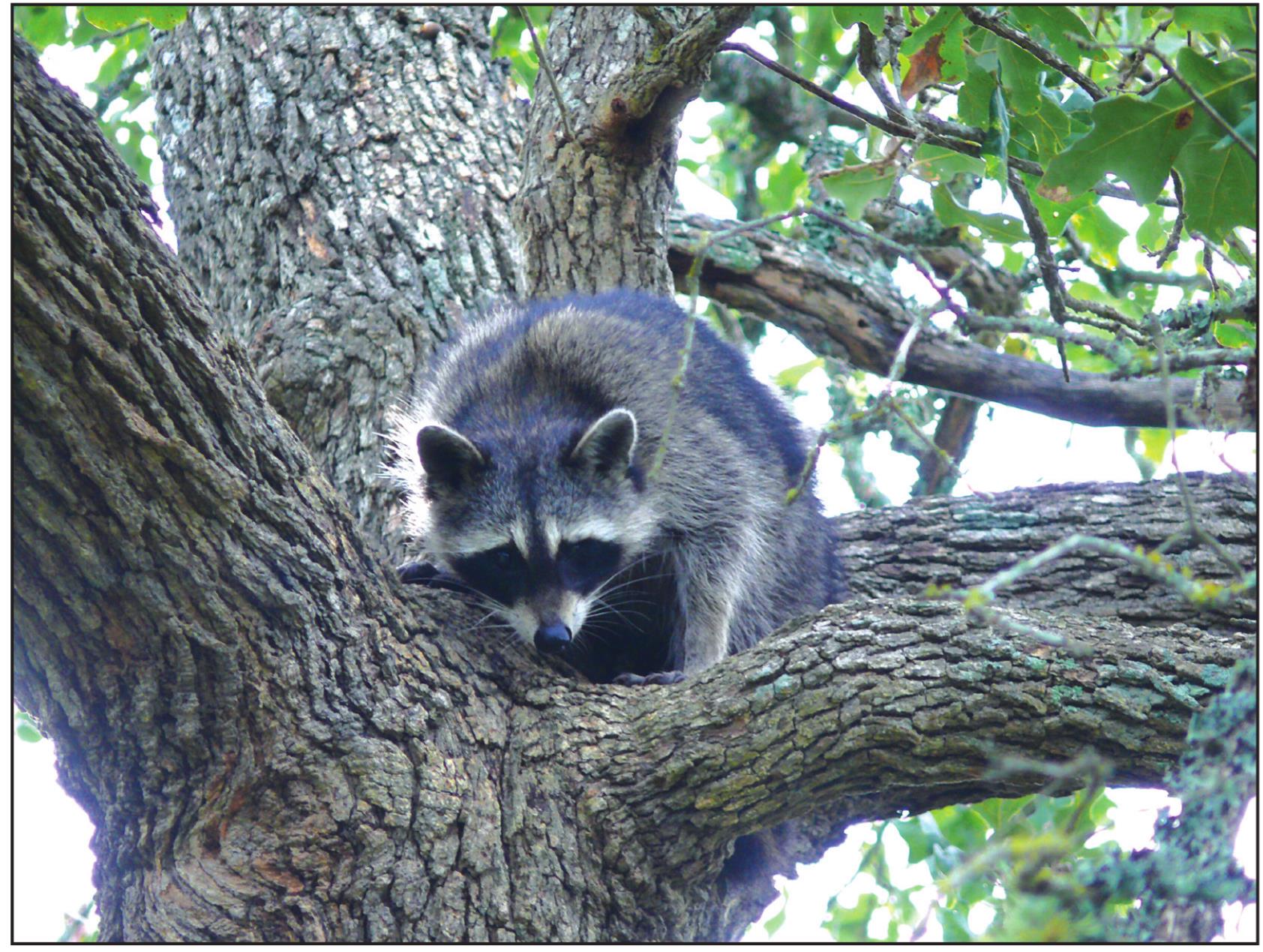
All of us who live in the country or the suburbs, or even sometimes in town, encounter members of our native wildlife community at least occasionally. But how much do we really know about our furry friends? I hope to put together some information about all of the more common mammals here and in subsequent columns. I would guess that raccoons and skunks are among the most populous of our small native mammals, so I will start with them.
Northern Raccoon (Procyon lotor): Raccoons are certainly one of the most visible native animals not only in the Hill Country but throughout most all of Texas and the US for that matter. This is probably partly because they are so distinctive and easily recognized, partly because they have learned how to live in close proximity to us, and partly just because of their numbers. They are nocturnal, but commonly seen around dusk and dawn, or, if disturbed from their sleeping place, even during the day.
Most adult raccoons have a body length of about 2' and weigh between 10 and 25 pounds. They are omnivorous, with berries, acorns and nuts making up around half of their diet, and insects, especially grasshoppers, also being a large part of their diet. But they also eat reptiles, amphibians, small mammals, baby birds and bird eggs. Texas persimmons and prickly pear tunas are favorite foods in the Hill Country.
They den just about anywhere that offers protection, hollow trees or logs, underground dens, in rock crevices, under barns, sheds or other man-made structures away from much human activity. Females bear three to six young in the spring and will use the same den until the young are about two months old, after which the family group may wander and sleep in different sites every day.
They readily climb trees either to escape predators or in search of food. They can climb down a tree either head first, like a squirrel, or rear first, like a bear. They are also fond of creeks, streams and lakes where they may find crawfish or other invertebrates. They do not hibernate in the Hill Country, but may stay holed up in a den for days during really cold spells. The average raccoon in the wild lives about three to five years or less.
The other two members of the raccoon family (Procyonidae) are ringtails, also native to the Hill Country, and the whitenosed coati, native to south Texas.
There are five species of skunks in Texas, four of which can be found in Kerr County. By far the most common is the striped skunk (Mephitis mephitis), followed by the hog-nosed skunk (Conepatus leuconotus) and the less-common spotted skunks; western spotted skunks (Spilogale gracilis) and the eastern spotted skunk (Spilogale putoris). Everyone knows what a striped skunk looks like. The hog-nosed skunk has a white back, not striped, a white tail, a long nose but no white mark between their eyes, and very long front claws. Spotted skunks are, as you might have guessed, spotted.
Skunks are omnivorous, their favorite foods being insects, particularly grasshoppers, beetles and crickets. They also dig for grubs and worms. They won't pass up any opportunity to take bird eggs or small birds, and they love fruits, berries and nuts. The hog-nosed skunk will plow through the ground looking for grubs and worms, which is why it is sometimes call the "rooter skunk."
Striped skunks breed in late winter to early spring and have four to seven young in May or June. The young have striped skin, are blind at birth, and develop musk before they are two weeks old.
Skunks are not generally that fearful of humans, or predators in general. They can usually be quietly approached to within 10 or 15 feet. Presumably this apparent tameness is because their defense isn't to flee but to spray. They usually, but not always, will warn you by stamping their front feet and clicking their teeth. But if they raise up on their front feet, run! They can usually spray multiple times if they need to.
Skunks will den in any available hollow log, crevice, or other shelter, including old armadillo burrows or other abandoned small animal burrows. They are largely nocturnal, but being out in the daytime is not that uncommon. They do not hibernate around here, but will sleep through winter cold spells.
There are lots of other critters out there that will be the subject of future columns.
Until next time….
Jim Stanley is a Texas Master Naturalist and the author of the books "Hill Country Ecology," "Hill Country Landowner's Guide" and "A Beginner's Handbook for Rural Texas Landowners." He can be reached at <jstmn@ktc.com>. Previous columns can be seen at <www.hillcountrynaturalist.org>, or at Riverside Nature Center at <https://riversidenaturecenter.org/past-blogs-from-a-friend/>.