
The Big Four Grasses of the Tall Grass Prairie
Two hundred plus years ago there were somewhat fewer woodlands, fewer trees scattered on the savannas, and more grasses in the Hill Country than we see today. Back then the prairies that stretched from Canada to Texas (the southern end of which was in the Hill Country) supported huge herds of migrating buffalo, as well as grazing elk and antelope. This area was called the “Tall Grass Prairie,” and the reason for that name was that the dominant grasses that grew back then were indeed “tall.” There are many reports of early explorers referring to the grass as “as high as a saddle horn.”
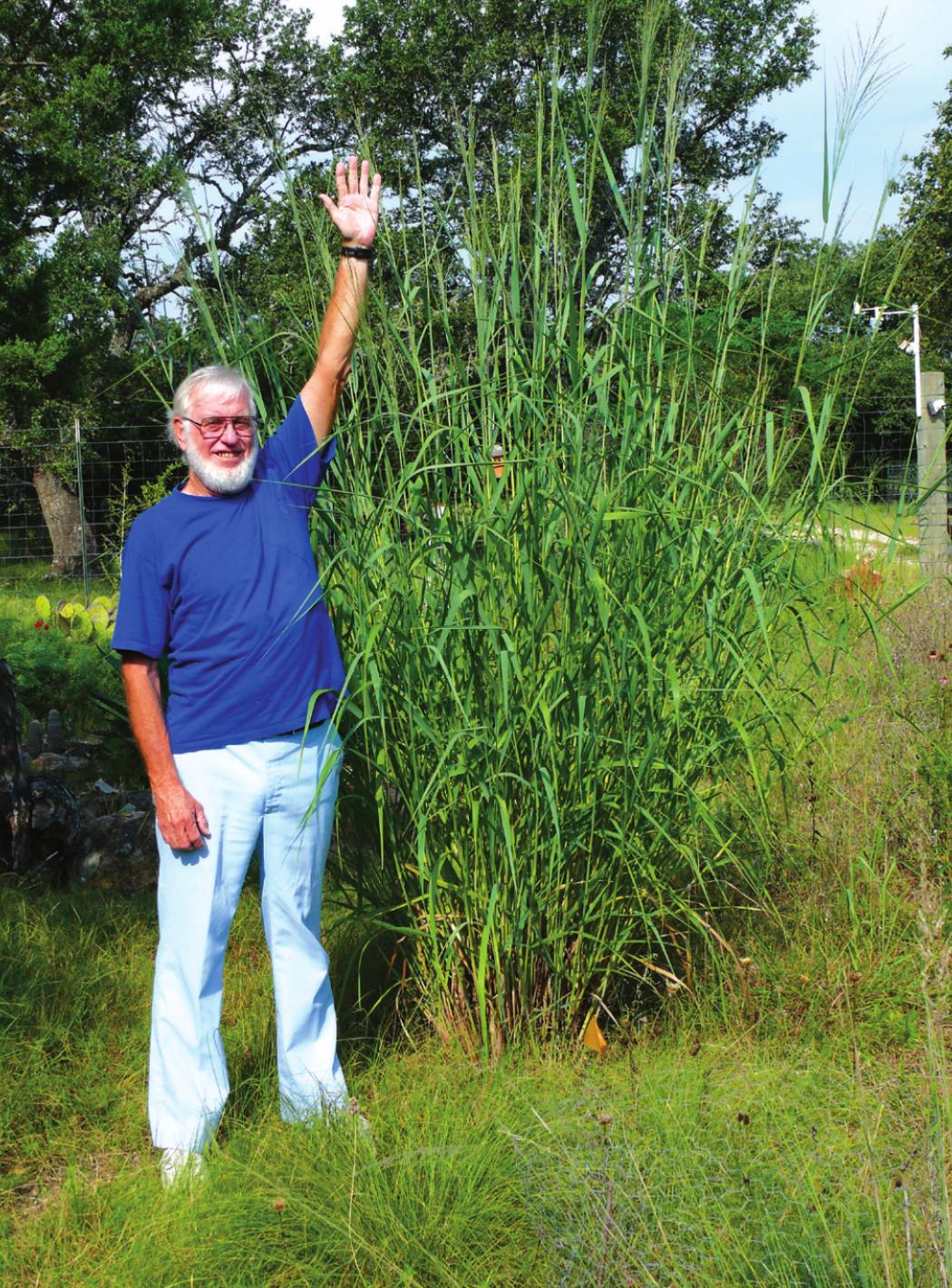
The four grasses that made up a large part of that grass community were little bluestem (Schizachyrium scoparium), big bluestem (Andropogon geraridii), yellow indiangrass (Sorghastrum nutans), and switchgrass (Panicum virgatum).
Of the four, little bluestem was probably the most common and wide-spread of all the grasses. In central Texas it is believed that over half of all grass plants were little bluestem. It is characterized as a bunchgrass about the size of a basketball with leaves two to four mm wide and 12 to 18 inches long. It puts up multiple stems in late summer which are usually two to four feet tall, but can be up to six feet tall. Between the nodes, the stems are alternately red and green. Fluffy seeds are produced along the top half of the stem. In late fall the stems turn a reddish brown and remain standing throughout the winter.
Little bluestem is often used as an indicator of the range condition: healthy ranges will almost always have significant amounts of little bluestem, whereas overgrazed ranges may have little or none. Little bluestem is often seen as the first of the tall grasses to return to recovering ranges.
Big bluestem, in contrast, looks nothing like little bluestem. It has wider leaf blades (five to 10 mm), and longer blades (18 to 24 inches) and it puts up many fewer stems. Seeds are produced on two to four branches near the top of the stem, the angle between the branches being about 30 to 45 degrees. It is sometimes referred to as the “turkey foot grass” because the common three seed branches reminds some folks of a turkey foot. These stems can be very tall (over eight feet), although in our part of the Hill Country I have never seen any over about six feet.
Big bluestem is probably the least common of the big four grasses to be found in the Hill Country—finding it is an unusual event. In my personal experience growing it, it seems to be the hardest to propagate and the one that requires the most water.
Yellow indiangrass has blades that are 10 to 15 mm wide and taper to a narrow base and to a long tip. The several stems can be from six to 10 feet tall, although most often in this part of the country are around six feet or less in poor rain years. The leaves are rough when rubbed backwards (toward the base). When in bloom in early fall, parts of the flowers are bright yellow, thus the name. These grasses are sometimes planted as ornamentals in landscapes.
Switchgrass is the biggest grass of the big four, and it produces significant growth earlier in the year than the others. The blades are one to two cm wide, and it produces many stems that can be from six to 10 feet tall, usually closer to six feet in this part of the country. It produces an open multi-branched seedhead that somewhat resembles the invasive Johnsongrass (the latter, however has a white stripe down the length of the leaf blade, switchgrass does not). It is also found growing in riparian areas.
Because Switchgrass is easy to grow, requires little extra water in most areas, and produces a large amount of biomass, it has been considered as a source of renewable energy if the technology of converting cellulose to ethanol ever becomes a reality.
All four of these grasses are good forage grasses for grazers and good grasses to have on any healthy rangeland or native habitat. These grasses, with their deep, massive root systems and the microorganisms that live in the soil among these roots are largely responsible for the fertility of the Great Plains which we have turned into the breadbasket of the world. But, more recently, we have overused much of this region.
Until next time…
Jim Stanley is a Texas Master Naturalist and the author of the books “Hill Country Ecology,” “Hill Country Landowner’s Guide” and “A Beginner’s Handbook for Rural Texas Landowners.” He can be reached at <jstmn@ktc.com>. Previous columns can be seen at <www.hillcountrynaturalist.org>, or at Riverside Nature Center at <https://riversidenaturecenter.org/ past-blogs-from-a-friend/>.