
Native Hill Country plants that need our help
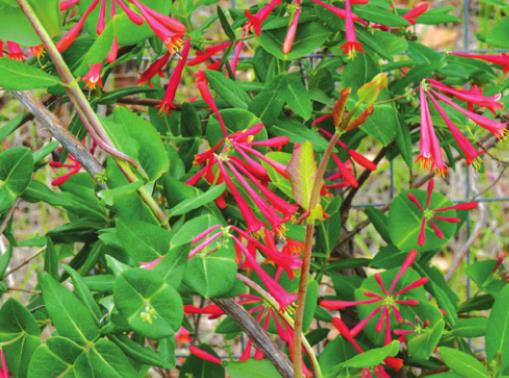
There are a number of native Hill Country plants that may be either declining in numbers or are seen only occasionally or rarely. The reasons for declining or low numbers of these plants can be either the high deer density in our area or any of several other factors. If enough people grow these plants, we can help to maintain the genetic diversity of the species in the Hill Country.
Here is a partial list of these plants.
Both Spanish oaks and blackjack oaks are declining in the Hill Country. Both species are susceptible to oak wilt, although that is probably a minor problem, but both seem to be unusually susceptible to hypoxylon. Spanish oaks also suffer from wind damage more than most trees. But the real problem is that the new sprouts of both species are deer favorites, and therefore we almost never see any new Spanish oak or blackjack oak trees. Spanish oaks are readily found in nurseries (do not buy a Shumard oak instead for planting around here—it doesn’t do well longterm in our soil). Blackjacks are almost never found in nurseries. The most successful way to grow more of either of these oaks, or anything else for that matter, is to cage any new young sprouts you find to keep the deer away.
American and slippery elms can become large trees especially in deep-soil bottomlands and along stream sides. Given the widely scattered nature of these elms in the Hill Country, Dutch elm disease is probably not much of a concern.
Blanco crabapple is a beautiful shrub that is only found in a small area in the Hill Country, as is Rusty Blackhaw Viburnum. Bigtooth maples, the trees famous for fall color at Lost Maples State Natural Area are only found in small areas in the Hill Country, and in parts of Big Bend, but they can be successfully grown most anywhere. All three of these shrubs and trees can be found in some local native plant nurseries.
Both the smaller Texas mulberry and the larger red mulberry are sometimes to be found in nurseries and should be easy to grow. Do not be confused and buy an invasive exotic paper mulberry!
Other shrubs that are very uncommon in the wild include Texas barberry (a cousin to agarita), sycamore-leaf snowbell, American smoke tree, canyon mock orange, and madrone. Most of these are very hard to find in nurseries, and madrones are difficult to grow under any conditions. If you find any of these on your property, I would urge you to cage them from the deer. Young madrones are usually found growing up under large cedar bushes where they are protected from the deer.
Some less common vines include coral honeysuckle, trumpet creeper, and passion vine, and most of these can be found in native plant nurseries.
A forb (wildflower) that was believed to have gone extinct in the Hill Country was discovered a few years back by the late Bill Ward, a friend, Naturalist and Geologist. Big red sage is now available in many native plant nurseries and makes a beautiful three- to four-foot tall plant with red tubular flowers attached to a tall spike. It is a deer favorite, so it must be planted in areas where deer cannot reach.
Another plant that is only rarely seen in our part of the Hill Country but is common further north and east is big bluestem. This is one of the “big four” grasses of the Great Plains (along with little bluestem, switchgrass and yellow Indiangrass) and grows to five or six feet. Fortunately, the seeds are available, and deer won’t eat it.
I am not suggesting that any of these species are necessarily in danger of extinction, although some could be in the future. But in the interest of a healthy, diverse habitat, the more of us who manage to plant and grow some of these plants, the better the chance that they will never be in danger of extinction. And many of these plants are host plants for specific butterfly species and/or sources of food for many birds.
Inside our deer-proof fence we now have two eight- to 10-foot tall blackjack oaks plus several smaller ones, a seven-foot tall Spanish oak, a large colony of big red sage, several coral honeysuckle, trumpet creeper and passion vines, and two sycamoreleaf snowbells. None of these can be found outside the fence! In the pasture we discovered a four-inch tall Spanish oak and caged it; it is now about 12 feet tall!
Until next time…
Jim Stanley is a Texas Master Naturalist and the author of the books “Hill Country Ecology,” “Hill Country Landowner’s Guide” and “A Beginner’s Handbook for Rural Texas Landowners.” He can be reached at <jstmn@ktc.com>. Previous columns can be seen at <www.hillcountrynaturalist.org>.