
Last month, I was watching a herd of deer gathered around a feeding station where feed had apparently just been dispersed (a practice I don’t recommend). Then all of a sudden, the entire herd bounded off in one direction, tail flags up, clearly having been spooked by something. Then a few seconds later I saw a lone coyote trotting up from the opposite direction. He had obviously lost the element of surprise and decided not to try a, probably futile, pursuit. He sniffed around the feeding area for a short time and finally trotted off in a different direction.
This event got me to thinking about the relationship between predators and prey, how complicated it is and how it is often misunderstood. The word “predator” usually conjures up thoughts of large predators, wolves, bears, cougars, lions, etc., but most predators are much smaller, and are interested in correspondingly small prey.
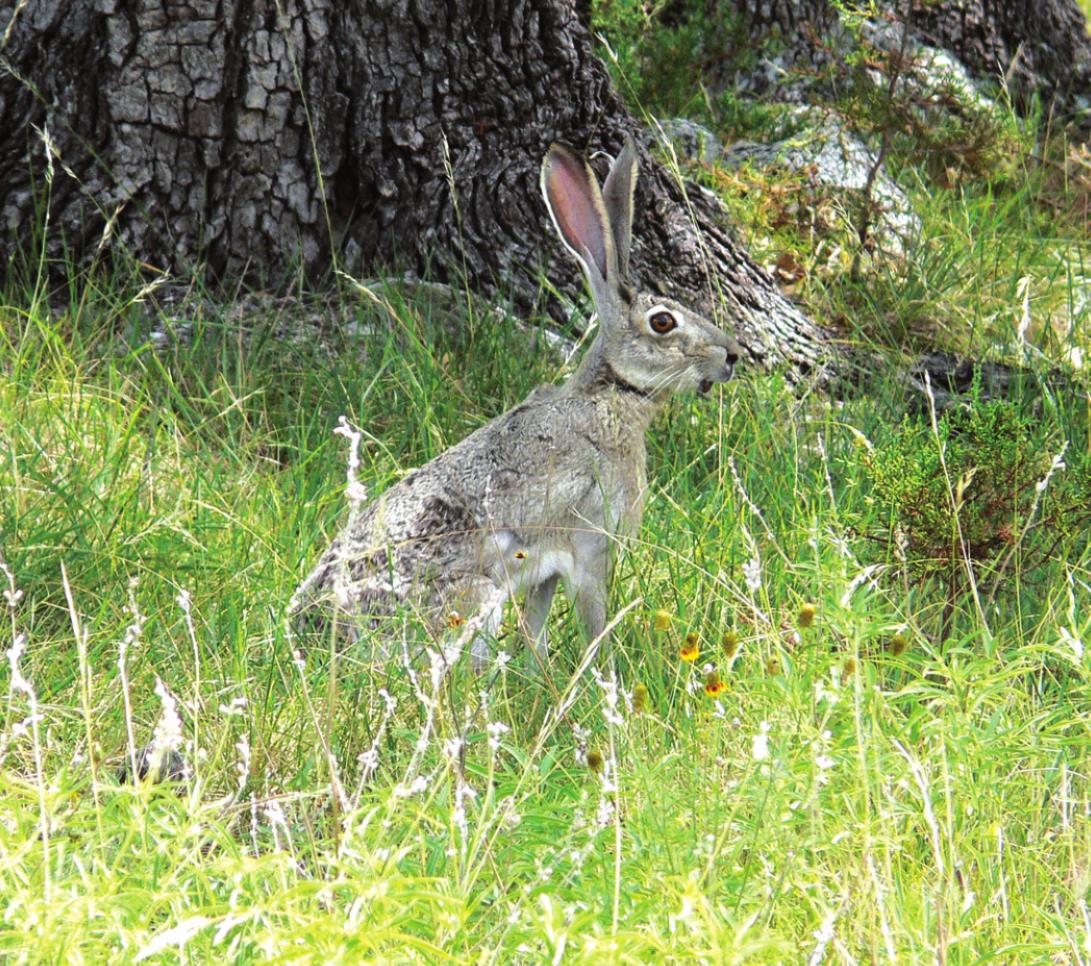
Quail, for instance, have to worry about many different predators, including hawks, most all of the small omnivorous mammals, snakes (mainly after eggs and chicks), and even non-native predators such as feral cats and hogs. Songbirds have to worry about hawks, snakes, ringtails, feral cats, and occasionally, other birds as well. Small mammals such as rats, mice, rabbits and hares are a favorite food of nearly all predators including hawks, owls, coyotes, foxes and snakes.
Also, we can’t lose sight of the fact that some animals are both prey and predator, avoiding capture by larger predators and preying on smaller species. Which means that to be completely accurate, most species are really omnivores.
Insect eaters are predators as well, and these include flycatchers such as mockingbirds and phoebes, frogs, toads, and lizards, and mammals such as skunks, armadillos, bats, shrews, mice and rats. Herons and egrets prey on small fish, crawfish, frogs and snakes. Ospreys take fish, as do some water fowl.
The point is that there are lots of animals that are predatory on other animals for at least some of their food, and there are lots of animals that are potential prey for numerous predators.
We humans tend to take sides in these predator-prey encounters, especially when we watch lions chasing an antelope on TV and, consciously or unconsciously, begin rooting for the antelope. Even though, biologically, we humans are also predators, we tend to think prey animals are more to be protected than predators. But from the standpoint of a healthy ecosystem, both types of species are important.
When European settlers began moving into Texas, most of them brought with them domestic livestock: cattle, sheep, goats, pigs and chickens. All of these exotic animals were slower and easier prey for the resident predators than most of the native prey animals. But the domestic animals were very important to the very survival of the settlers, so they shot just about all predators on sight.
Thus began the elimination of our larger native predators. The last bear and wolf were killed in Kerr County just over a hundred years ago. Not all of the killing of predators was done by people protecting their livestock. Many hunters have also contributed to the reduction in predator numbers in the belief that fewer predators means more prey game animals (quail, dove, ducks, deer).
This belief, however, fails to take into account that prior to settlement, there were much greater numbers of all predators, especially large ones (wolves, bears, mountain lions), coexisting with sizeable numbers of large prey animals (deer, elk, antelope, bison). The elimination of large predators is generally given as the main reason for the increase in white-tailed deer throughout the state. However, the last major predator of deer, the screwworm fly, was eliminated by the USDA in the 1960s, not by hunters.
We are now left with the situation of almost no natural predators of white-tailed deer, and the overpopulation of deer to the point of destroying the native habitat for themselves and other wildlife. We are clearly not going to try to return the wolf to Kerr County, but we should recognize the fact that predators play a useful, important part in maintaining a healthy ecosystem, and the prey animals are not necessarily more important or more deserving of protection than predators.
An ideal, healthy, sustainable, ecosystem would have predators and prey in such numbers that the predators would not take more prey animals than could be replaced in the next year and the prey (herbivores) would not take more forage than the vegetation could replace in the next year. Under these conditions the “balance of nature” could be maintained long term. We haven’t yet figured out how to attain such an ecosystem without the natural predators.
Until next time…
Jim Stanley is a Texas Master Naturalist and the author of the books “Hill Country Ecology,” “Hill Country Landowner’s Guide” and “A Beginner’s Handbook for Rural Texas Landowners.” He can be reached at <jstmn@ktc.com>. Previous columns can be seen at <www. hillcountrynaturalist.org>.