
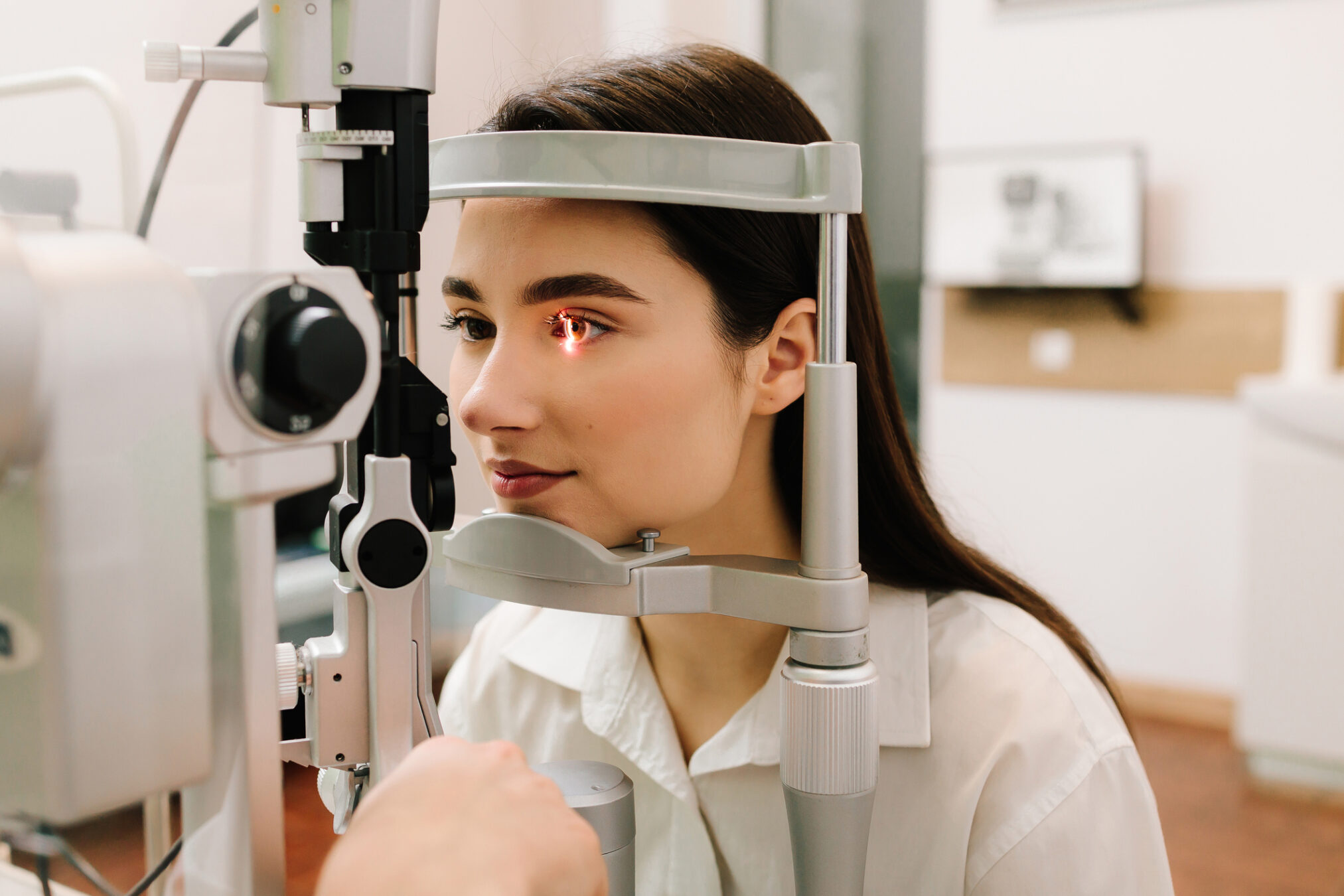
Texas A&M graduates are developing a headset-style eye exam device designed to bring eye care to more patients.
By Emma Lawson, Texas A&M University Division of Marketing and Communications
Around 75% of American adults need vision correction, but access to eye care remains uneven, particularly in rural communities and for patients with mobility limitations.
To help close those gaps, Dr. Nick Panzo and Dr. Hamza Memon, graduates from the Engineering Medicine (EnMed) program offered by the Naresh K. Vashisht College of Medicine, are developing portable eye exam equipment about the size of a virtual reality headset. The device is designed to make comprehensive eye exams more accessible by bringing a key piece of ophthalmology equipment out of clinics and into a wider range of healthcare settings.
The project reimagines the slit lamp, a standard diagnostic tool used during eye exams to detect conditions such as cataracts, corneal abrasions and glaucoma. Traditional slit lamps require a patient to rest their chin and forehead against a stationary machine while an ophthalmologist examines the eye using a narrow beam of light.
The equipment’s size and fixed design can make examinations difficult or impossible for patients who cannot comfortably position themselves at the machine. Panzo and Memon’s headset-style device is designed to be portable and adjustable for a wider range of patients.
Panzo and Memon inherited the slit lamp headset project from previous EnMed student Dr. Zachary Richards and expanded its focus to address limited access to eye care in rural communities.
“Eye doctors are mainly concentrated in cities, and when they are in rural areas, they can be very busy or have long delays for patients to make appointments,” he said. “It’s even more difficult when it comes to some subspecialities.”
The portable slit lamp headset would allow ophthalmologists to connect wirelessly to the device, supporting telehealth consultations and enabling specialists to evaluate patients remotely.
“This idea stems from increasing availability of eye exams to the public,” Panzo said. “Our goggle-based headset would allow providers to remotely triage and assist patients that aren’t physically able to see a specialist.”
Beyond expanding access to care, Memon said, the team also plans to incorporate imaging capabilities that would allow clinicians to capture and store high-quality images during examinations.
“The main target is rural medicine, but there are other aspects where this project could be utilized,” he said. “Currently, ophthalmologists look through the scope of the slit lamp and record their findings, but the images seen aren’t stored. Our product could be used for monitoring the progression of patients’ pathology by taking photos and tracking their changes.”
Memon said those imaging capabilities could also benefit medical education by allowing clinicians to share detailed images of complex cases.
“A slit lamp like this, where the images are captured in high quality and shared among students and trainees, opens up a whole new side of education,” he said. “Once you have images, you can collaborate with other specialists in your field. You can send these photos over and say, ‘I have this patient that’s very complex. I would love your input.’” Dr. Hilary Beaver and Dr. Andrew Lee served as mentors and key clinical collaborators throughout the project. Other collaborators on the slit lamp project include Dr. Rijul Nanda and Rohan Gupta.