
As the flesh-eating parasite edges back into the United States, public health experts explain who is most at risk and what safety habits can prevent transmission
By SADDIE SMITH for VITAL RECORD
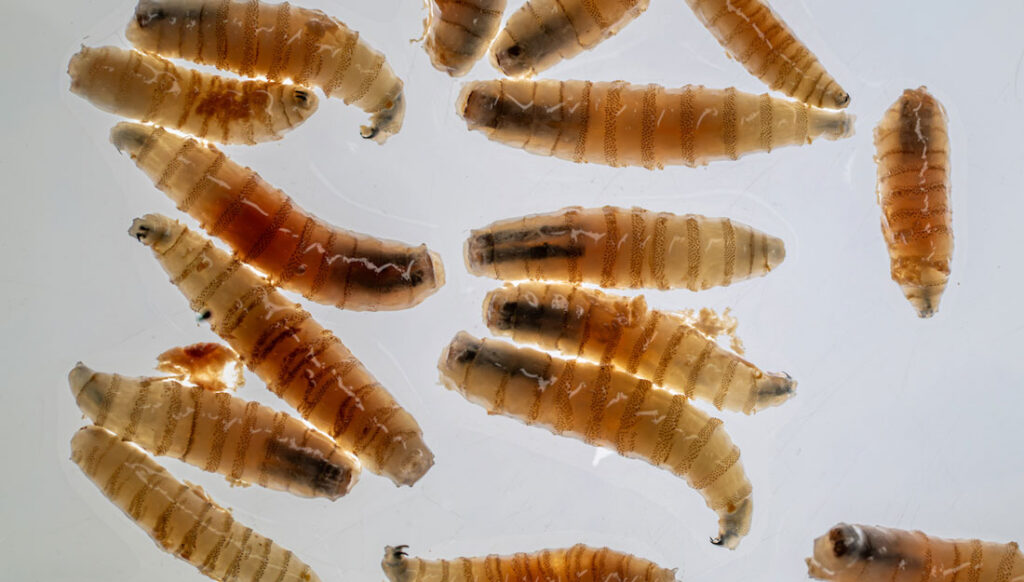
Reports of the New World screwworm returning to the United States have raised concern. Driven northward from Central America and expanding across our southern borders, this parasitic fly has officially reemerged after a 44-year absence, according to the U.S. Department of Agriculture (USDA).
While ranchers and veterinarians know the parasite as a threat to cattle, the idea of a flesh-eating fly larva raises questions about potential impacts to humans.
To help answer these questions, we spoke with three experts at Texas A&M Health.
Loni Taylor, PhD, DVM, MPH, is an interdisciplinary veterinary epidemiologist and assistant professor at the School of Public Health, where she directs the Center for Worker Health. She specializes in zoonotic diseases, infectious disease prevention and the safety of agricultural workers.
Anabel Rodriguez, PhD, MPH, is an occupational epidemiologist and assistant professor in environmental and occupational health at the School of Public Health. Her research focuses on infectious disease prevention, health equity, and the health, safety and well-being of agricultural and immigrant workers.
Moriya Tsuji, MD, PhD, is a professor and renowned infectious disease researcher at the School of Engineering Medicine known for his work in immunology and vaccine development.
Here, they break down what happens when screwworms meet human health.
What exactly is a screwworm, and why are people talking about it again?
Despite the name, a New World screwworm isn’t a worm at all; it’s the destructive larval stage of a parasitic blow fly. The adult flies have metallic blue-green bodies and orange-red eyes, but the larvae cause the risk, according to the American Society for Microbiology.
The United States eradicated the pest in the early-1980s using the sterile insect technique, which involved releasing millions of sterile male flies to mate with wild females and crash the wild population, in addition to monitoring and animal treatments. Decades of successful eradication from the United States followed by this recent resurgence have left a significant gap in public awareness, where a generation of people have not experienced living with this fly.
“Many clinicians, practicing in areas that have been free of screwworm for decades, have never encountered a human case,” Taylor said. “That geographic expansion means we need to educate both patients with chronic wounds and healthcare providers who might not recognize the risks to their clientele.”
Can you “catch” screwworms from eating meat?
No, screwworms are strictly external parasites that require a living host with an open skin break to survive, according to the USDA. They cannot survive the human digestive tract, nor are they transmitted through food. They do not move between hosts, and they do not survive on dead hosts, as other blow fly species do. They can only infest a living animal by the female laying eggs in the wound.
Furthermore, federal inspection protocols at processing plants ensure that any animal showing signs of active lesions or disease is discarded and kept entirely out of the consumer food supply. This is a parasitic infestation of fly larvae, not a disease or infection.
Is this just a livestock problem, or are humans at risk, too?
Because screwworm primarily infects livestock and wildlife, it may be easy to dismiss it as purely a veterinary issue. However, adult screwworm flies will lay eggs quickly in any vulnerable open wound or sore on both animals and humans. In infested areas, simply walking outside with an exposed break in the skin, regardless of how small or unnoticeable the wound might be, is enough to attract a fly and trigger a severe larval tissue-feeding infestation, according to Cleveland Clinic.
Eggs hatch within 12 to 24 hours of being laid. Larvae then use their screw-like body ridges to enter wound sites and feed on healthy tissue. Medically, this parasitic infestation is called wound myiasis. Although rare, if left untreated, myiasis can lead to secondary bacterial infection, which can progress to septic shock, a severe, life-threatening condition.
Taylor explained that three groups of people face the highest risk in an active outbreak area:
- Agricultural and outdoor workers: Ranchers, field hands, veterinarians and crop harvester crews who spend long hours outdoors and sustain frequent minor cuts could be at higher risk.
- Individuals with chronic wounds: People living with diabetes, vascular disease or neuropathy may experience chronic ulcers on the legs or feet, which can dull sensation. Medical professionals who aren’t trained to identify symptoms of New World screwworm infestation may mistake early infestation for standard disease progression.
- Homeless and vulnerable individuals: Anyone with limited healthcare access and anyone with a limited ability to perform basic medical care, including checking wounds daily, could also be at risk. A simple delay in evaluating a routine injury can give an infestation time to progress.
Can a minor scratch really attract a fly, or does the wound have to be huge?
You don’t need a major injury to attract a screwworm, Rodriguez noted. In fast-paced environments, agricultural workers often deal with friction abrasions, tool slips and tiny wire cuts. The fly simply needs a tiny break in the skin to deposit its eggs.
“Small wounds are just as likely to be infested,” Rodriguez said. “You can have a small lesion that becomes infested just as easily as a larger, deeper one.”
In a fast-paced work environment, is it really that bad to ignore a minor paper cut or scratch?
In agriculture, work moves fast. Whether feeding livestock on a strict schedule or harvesting crops, it’s tempting to just keep working with a sliced finger. That brief delay is all a New World screwworm fly needs, Rodriguez said.
“I’ve seen this over and over in the field: People slice their finger, and because it’s just a little scrape, they say, ‘I’ll clean it when I get home,'” she said. “But these are the moments to be proactive. Taking three minutes to pause, wash it out, clean it up and tape it over with a bandage or glove keeps you safe.”
Rodriguez emphasized that farm labor contractors should keep fully stocked first-aid kits in work vehicles and field sheds, so workers have the appropriate equipment to cover injuries instantly.
What practical gear keeps the flies off you outdoors?
The good news is that New World screwworm risk prevention isn’t much different than commonly used sun and bug protective measures. Rodriguez said standard gear used for sun and heat protection doubles as insect defense:
- Cover exposed skin: Wear long-sleeved shirts, heavy denim jeans, work boots and neck gaiters.
- Treat every break in the skin: Even minor friction blisters, cracked scabs or insect bites should be kept clean, taped and covered until completely healed. Continue inspecting wound sites for maggots. The early-stage maggots are very small, so look carefully, and seek medical attention immediately if you suspect an infestation. The feeding larvae cause considerable pain. Don’t ignore these symptoms—be proactive and examine the wound carefully.
How can you tell the difference between a normal infected cut and a screwworm infestation?
The primary clue is a wound that simply fails to heal or scab over like a normal cut would, Rodriguez said.
Tsuji noted several red flags to watch for:
- Severe, sharp pain: Pain that feels far worse than a typical minor cut.
- Worsening appearance: Instead of a flat, open sore, the infestation creates a deep, burrowed cavity beneath a relatively small surface opening, hiding a tightly packed cluster of feeding larvae. Maggots do not always present at the skin surface.
- Unusual fluid: Instead of thick, yellowish pus, the wound produces a thin, bloody and foul-smelling discharge.
- Visible movement: Patients often report a distinct crawling, writhing sensation beneath the skin or visible larval movement inside the lesion.
“If you see a wound that isn’t closing and you’re seeing larvae, go to a medical provider immediately and tell them what you’re experiencing,” Rodriguez said.
Once removed, the maggots should not be discarded. Specimens should be submitted to your local health department for identification. Put them in a sealable container, such as a sealable bag or jar with a tight-fitting lid. If you cannot immediately get them to a professional, either freeze them or add rubbing alcohol to the container.
Can you treat a screwworm infestation at home?
Seek medical attention as soon as you suspect a screwworm infestation. Attempting home remedies, suffocating the larvae with household liquids, or pulling them out manually with tweezers is dangerous, according to the Texas A&M AgriLife Extension Service.
These flies are considered a foreign animal disease pest and must be handled by professionals for reporting and follow-up procedures. Knowing where you were when you were wounded or when you think you may have obtained the infestation can help agencies respond to eliminate the flies in the environment.
“Once an infestation with the larvae happens, the response is to see a medical provider right away so they can clean and cover the wound properly and submit the larvae for identification,” Rodriguez said.
What is the final word on staying safe this season?
While the return of the screwworm sounds alarming, experts emphasize that there is no need for panic—just be aware and prepared.
Researchers are already deploying diagnostic tools, including a portable DNA-based field test designed for rapid screwworm detection, according to the United States Geological Survey (USGS). Meanwhile, sterile fly releases and defensive livestock sprays continue to be used to eliminate the existing infestation and keep the fly as far from the Texas border as possible.
Taylor, Rodriguez and Tsuji all stress that the best defense for our communities is simple:
- Normalize good wound hygiene.
- Treat small cuts immediately.
- Keep injuries covered until healed.
- Report any suspicious, rapidly worsening wounds in humans, pets or livestock to a healthcare provider or local veterinarian right away.
- Be aware of where the fly has been found in Texas by tracking it on the USDA or the Texas Animal Health Commission
“The biggest thing is to consider the risks, prevent exposure and treat or seek medical treatment for any suspect wounds immediately,” she said. “Our focus is empowering people to know that prevention is in their control.”