
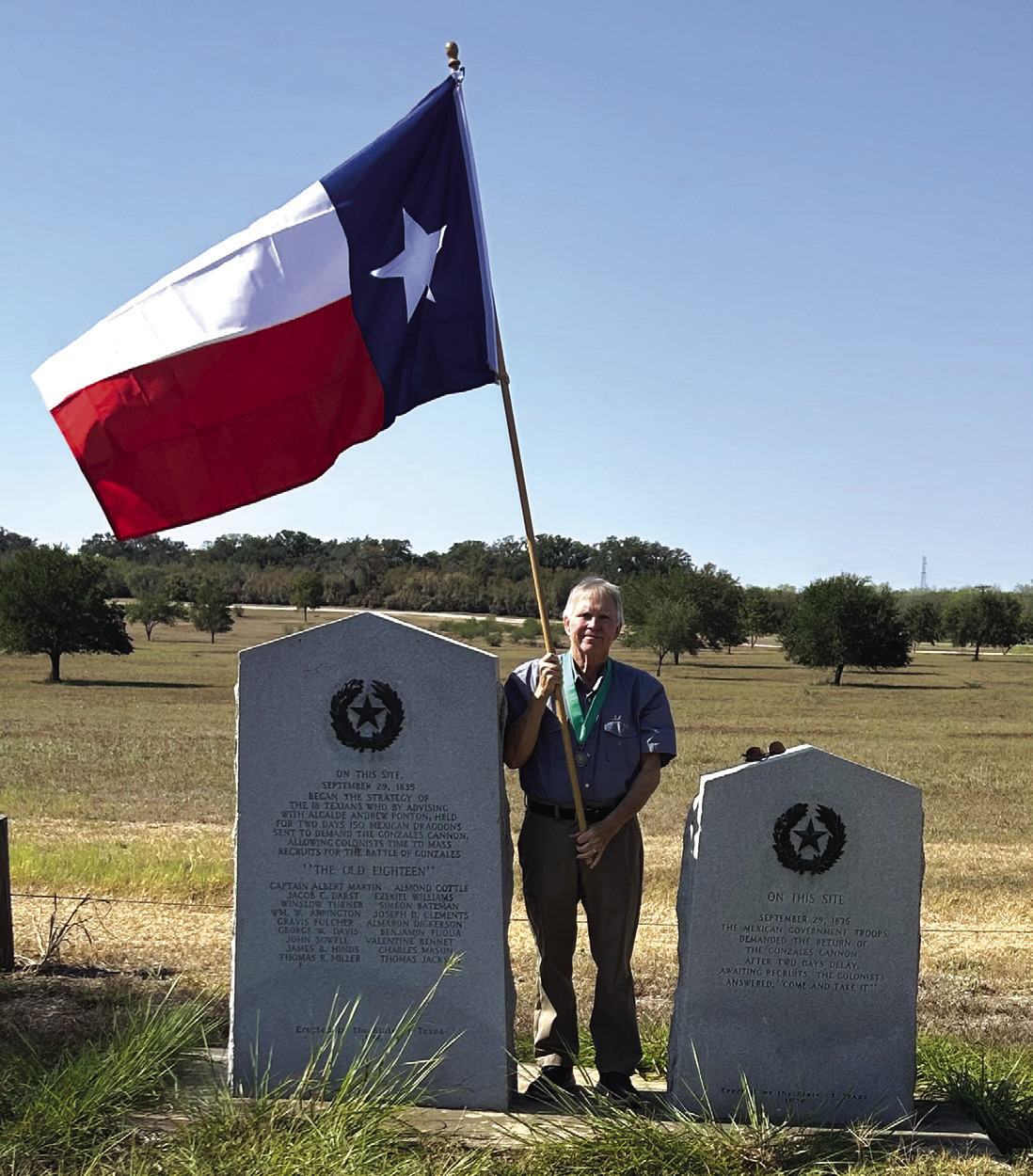
Sir Knight O. Scott Dunbar, KSJ who is also a 3rd great grandson of Sion Record Bostick, one of the men that Captured General Santa Anna after the Battle of San Jacinto in April 1836 and lived owned business including the Bostick Hotel until his death in 1902.
The highest honor bestowed by The Sons of the Republic of Texas is election of a member to knighthood in the Order of San Jacinto. This elite honorary organization was established in 1843 by General Sam Houston, leader of the victorious Texans at the Battle of San Jacinto. The honor is accorded to those who have rendered outstanding service to Texas, in keeping with the mission, purpose and goals of The Sons of the Republic of Texas. Only three members may be elected to the order in any one year.
To be eligible for Knighthood in the Order of San Jacinto, a person must be an active member of The Sons of the Republic of Texas, either by lineal descent or as an honorary member. In addition, he must have performed outstanding service to the State of Texas, made a sacrifice beyond the call of duty on her behalf, or by his talents and efforts, contributed to the proud heritage of Texas.
A Commemorative Lone Star Flag that was flown in 2016 for the 180th Anniversary of Texas Independence over each of the major events or battles as Texas strived for its victory to independence.
Now in 2026, we will celebrate the 190th Anniversary of Texas Independence by retracing the same event and battles with the same Commemorative Lone Star Flag that was flown in 2016.
I invite you to come along as we tell the history of the great men, women and in some cases children that were our forefathers and made Texas who She is today 'lest we forget.'
Our first of seven Historical sites is where it all started, Gonzales, Texas, and the Event we now call “ Come and Take It” October 2, 1835.
The Battle of Gonzales often referred to as the “Lexington of Texas' was the first battle of the Texas Revolution and occurred on October 2, 1835. Leading up to the battle, tensions had been growing between the Texians and the Mexican government as Santa Anna came to power. Many of the Texan settlers were from the United States, continuing to speak English and set up their own schools even as Mexican citizens. Santa Anna suspected the Texan settlers would try to declare independence when he overthrew the Constitution in 1835, so he ordered the Mexican army to disarm them.
A few years prior, a cannon had been provided to the residents of Gonzales for defense against Natives. In September of 1835, Lieutenant Francisco de Castañeda was sent to retrieve the cannon with a small group of Mexican soldiers. The Texians angrily refused to give back the cannon and arrested the soldiers that came to retrieve it. They then sent 100 Mexican dragoons under Lieutenant Francisco de Castañeda to retrieve the cannon once more. The Texians met them at the Guadalupe River and refused to negotiate or let them pass. While the Mexican troops decided to camp, 140 Texian volunteers arrived in Gonzales and elected Colonel John Moore to be their leader.
On the morning of October 2, 1835, the Texians attacked the Mexican camp. They loaded the cannon with scrap iron and fired the shot that began the revolution while flying their new “Come and Take it” flag. Ordered to avoid open conflict, Castañeda retreated with one casualty. He asked Moore why the Texians had attacked. Moore replied that they were fighting for the cannon and the Constitution of 1824. Castañeda sympathized with the colonists as he was also against Santa Anna’s new centralized government and retreated to San Antonio.
After their small “victory,” many Texians began to form militias around Texas. Now that Mexican blood was spilled, the rebellious Texians could not turn back.
This is when the former San Saban Sion R. Bostick, born 1819, arrived from Colorado County along with the others to stop Santa Anna's men from taking the cannon back; he heeded the call. Sion was the ninth of 10 children born to Levi T Bostick and his wife Martha Hill, they arrived in 1829 • Nacogdoches, Tejas, Republica de Mexico (Texas) from Alabama. After they went to Stephen F. Austin's Colony at San Felipe, Tejas, Mexico, they would later make their home on the Colorado River which is now Columbus, Colorado County, Texas. Sion was only 13 when his father died in 1832. Sion was described as an expert horseman and excellent shot. Two years later at the age of 15, he found himself at the beginning of the Texas Revolution when he arrived at the Guadalupe River in Gonzales that October day 1835.
Now we march on, just as the Texians did to Mission Concepcion in Bejar “San Antonio” for the Battle of Concepcion. October 28, 1835. Come, join me there.
O. Scott Dunbar, KSJ