
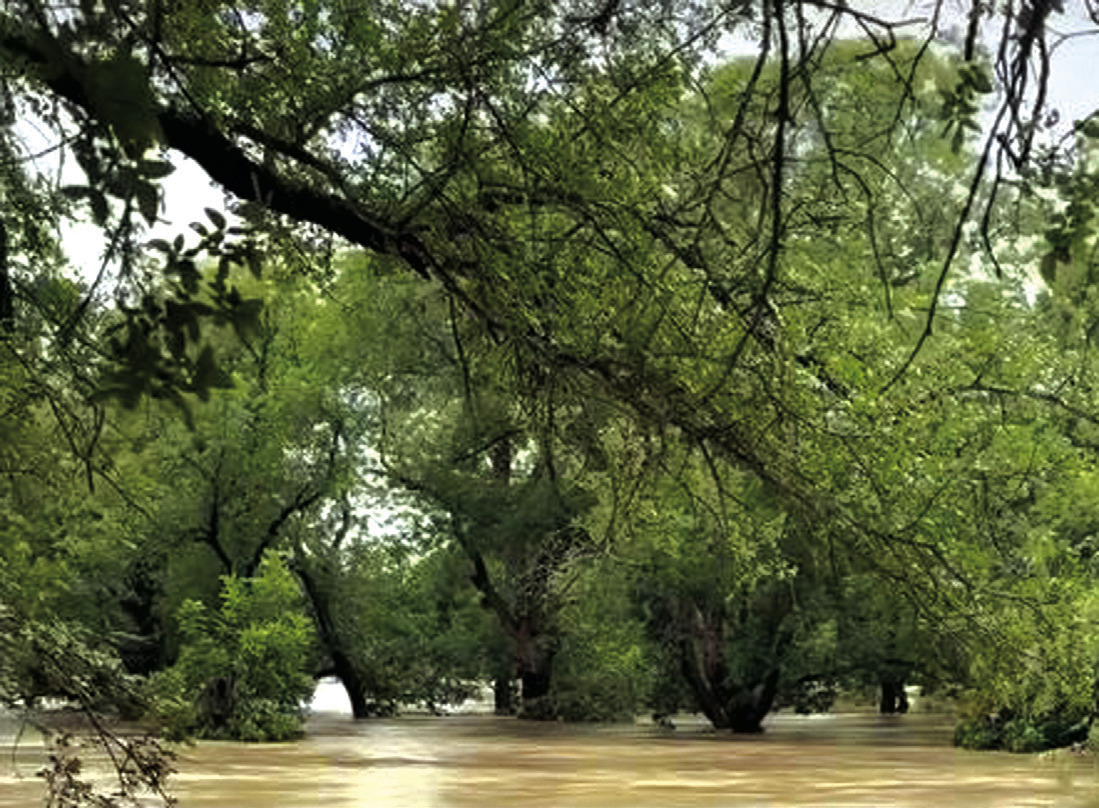
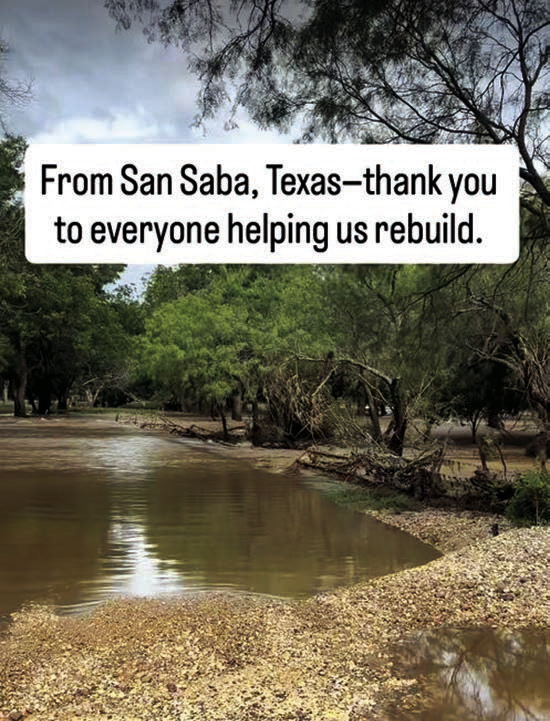
I spoke to Winston Millican on August 14th to get an update on Millican Pecan after the recent flooding. This information came from that meeting.
The Millican Pecan store was not flooded, but the neighbors got water in their house. The store is actually six inches out of the flood zone. The Millican’s got this building in 2006 and keep on adding on to the building.
Their personal houses were not affected. They live on a hill, but it was an island after the flood They couldn’t get to town.
The orchards went from drought to flood.
After the first flood, the trees that were planted in spring were all bent down flat. (There were 500 of these one-year-old trees.) On Monday after the first flood (July 7th), they went out and stood all the trees back up. After that, they started propping up fences and getting debris off the fences, trying to make sure the cattle didn’t get out.
Then the next week, after the 500 new trees were stood back up and two and a half miles of fence was put back up, the second flood came. After the second flood, those 500 new trees were all back down again. This time, they put in steel posts by each tree to prop them up.
On the 15-18 year old trees, the flood didn’t have a big effect on them except where the water was really flowing. If the water was up in the canopy of the trees, it broke the trees over. Some broke halfway up; others broke off at the ground, broke the scaffolding roots and just knocked them over.
The trees that were 25 feet tall, the water got up approximately 15 feet tall. The tree canopy acted like a sail, and it just tilted the whole tree over. The big trees were fine. A bunch of limbs, logs, and debris are around the trees, but the trees are alright.
The orchard will be all cleaned up by harvest time, and that won’t present a problem.
At harvest time, when they shake the little trees, more than pecans will come down. There is a lot of mud, leaves, grass, cactus, logs, limbs, and all sorts of stuff up in the trees.
Winston said he has an irrigation pump that is about 30 feet up in a pecan tree. The first flood moved the irrigation pump about 100 yards. The second flood moved it 400 yards, and it caught on the last tree in the orchard before it would have gone down the river to Lake Buchanan.
The river was very swift. Because they were stranded on their “island” after the first flood, they took the Ranger to places they don’t usually go. They were watching the second flood come up; the water was extremely swift. He stated that water usually has a 6 ½ mile an hour current with a flood. But in this particular location because the river was so narrow, and all that water was really flowing, it was scary. They took the Ranger right next to the river bank. The river started cutting through, and they almost got cut off. He chuckled and said they almost made the news from that.
The good thing about San Saba River, it is slow, and they had about eight hours of notice. They went and got cows out of four different river bottoms. Lost 19 cows in the flood and have found 13 of them. They found most of their cows between the two floods. Haven’t seen any extra cows since the second flood.
They lost irrigation pumps. As for the water wells near the river, the waters washed the pump houses away, pressure tanks, things like that. They had a neighbor who lost a Polaris Ranger, a skid steer, a sprayer, and maybe a fuel tank. Other neighbors lost two big tractors.
Cows were the most expensive things they lost, that and fences. They have about five miles of fence to rebuild/replace/rework. There is a lot of grass, limbs, and logs in the fence.
They started by working on perimeter fences to keep the cattle off the road so they wouldn’t wander on the county road. Winston said that from his house (at the mouth of the river), you could drive from there to San Saba, and there were no fences anywhere.
Winston also relayed the story of the jam in Lake Buchanan with a lot of dead cows. He said there is drone footage of it, but the drone couldn’t get close enough to see ear tags.
They did have trouble with well water. They have a hand-dug well. The flood waters moved the lid off of it, and the river water just poured straight into the well water.
A neighbor is a water-well man, and he treated the well for them. Winston said he turned his well on as soon as the water went down to make sure it worked; the electrical still worked.
Winston stated they are fairly blessed that we came out unscathed.
Winston also relayed this interesting tidbit about the flood. Where the mouth of the San Saba is, the river actually flowed upstream; at Shaw Bend, the river slowed upstream. It flowed backwards because there was so much water flowing out of the San Saba River. You can see the trees that got washed down pointing up stream.
He recalled that everyone kept saying, “I’ve never seen the water this high.”
The flood probably helped the trees more than it hurt them. Their ground is loam soil. When it dries, it cracks open. Air gets down in the soil. When the flood came, the water filled in all those cracks and pushed out all that air. He said “I have never seen this before. You would be standing out there, and you would hear the hissing and bubbling. If there was water on top of the ground, you could hear bubbling. If there wasn’t any water, you would just hear hissing.”
I asked if he sustained any damage from the wind/hail storms in June. He answered with, “I’ve had three insurance claims this summer.”
They were out of town at an airport, and they would get text updates from a neighbor during those June storms: beat all the barn roofs off, blew in all the doors, busted out windows, knocked over equipment.
Since there were no doors, all the rainwater just came into the building. Then, two weeks later, a hail storm blew the roof off of the shed. It just lifted it up and peeled it off. The other half of the roof was up high in a tree. They had been trying to figure out how they were going to get the roof down from up in the tree. Then all of a sudden one day, a gust of wind came, peeled it back out of the tree and put it back down. The barn still has to be replaced. They had about 15,000 feet of tin that was supposed to be replaced.
The hail storm beat the oak trees leaves/branches off. You couldn’t get finished with one disaster before the next one hit.
After the second flood, he said we won’t have to be in such a big hurry this time.
Winston said they are looking forward to a great pecan harvest. You can follow updates on their orchard on their Facebook page.
See article on Oliver Pecan.
See article on The Great San Saba River Pecan Company.