
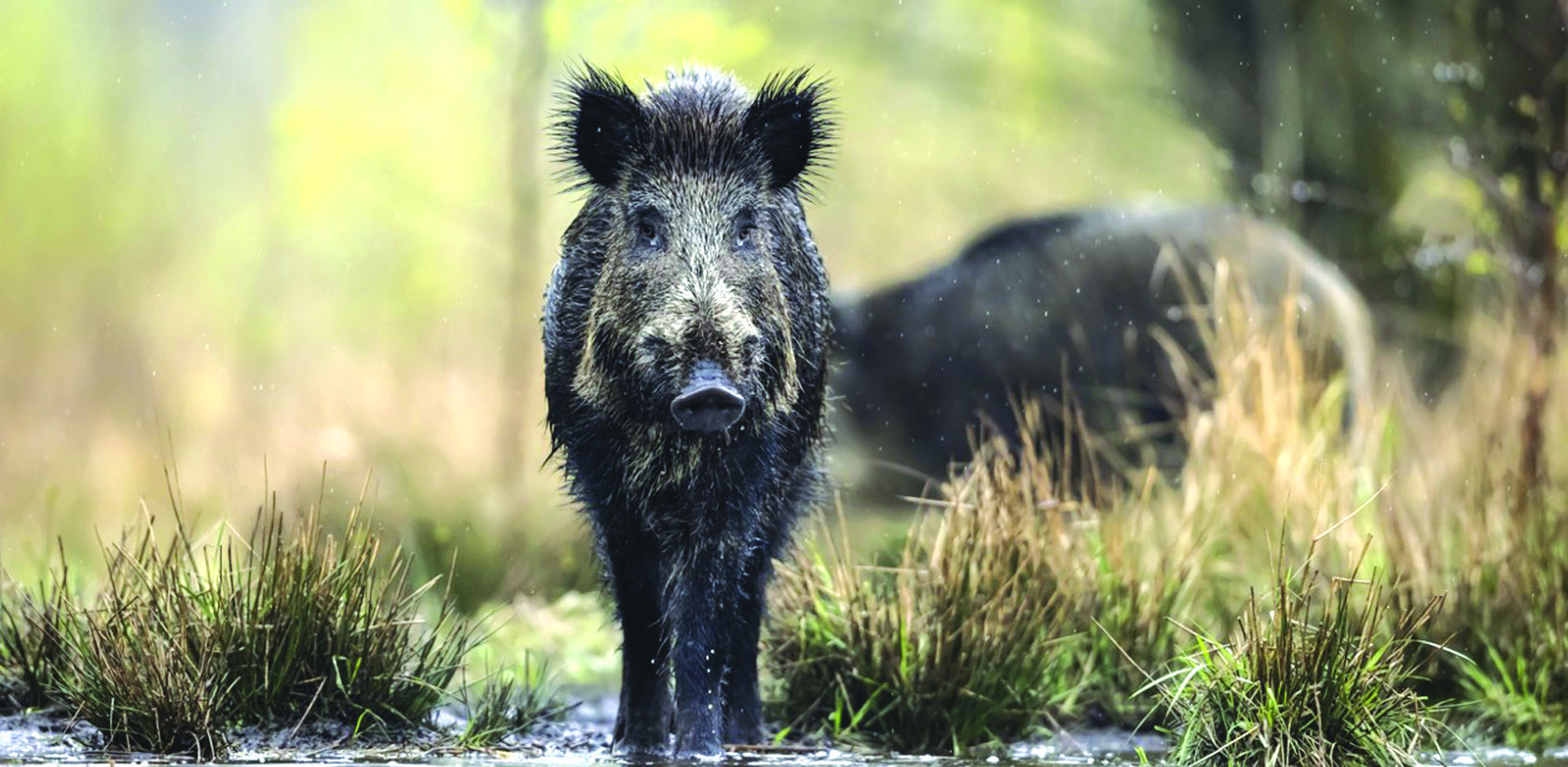
Feral pigs are widely considered one of the most invasive species that Texans battle across the state. They are opportunistic omnivores, meaning they consume both plant and animal matter, and can thrive in a wide array of habitats. Early Spanish explorers brought domestic pigs aboard their ships to America as a food source in the 1500’s. Since that time, and with more Europeans settling in the new world, pig escapes from holding pens and intentional releases created the original populations that landowners are battling today. Today, the estimated population of feral pigs in Texas is more than 3 million. Female feral swine have been documented to breed and conceive at 6 months of age. With a gestation period of 115 days, they can rapidly increase the population, causing more damage to the landscape.
Feral pigs are considered exotic livestock, and according to the Agriculture code 161.002, if exotic livestock are trapped or controlled, cared for, or marked or branded, that person assumes the role of caretaker and owner of the exotic livestock. In this scenario, feral pigs that are trapped, placed in a pen, and cared for are the person's responsibility, and the person must manage them accordingly. Because of this distinction, landowners can manage feral pigs on their properties through reduction practices or sale.
Agricultural Damage
In Texas, feral pigs occupy 250 out of 254 counties, excluding Dallam, El Paso, Hansford, and Sherman counties as of 2024 (USDA, 2024). It is also estimated that feral pigs create more than $670 million in crop damage, with an additional 200 million in control and mitigation costs (McKee et al. 2024). This does not include various other forms of damage caused by feral pigs, including vehicle collisions, water quality issues, and disease transfers to other species.
Hunting Regulations
Because feral pigs are an exotic livestock species, there are no regulations on bag or possession limits or a closed season. As of September 2019, Texas no longer requires a hunting license to hunt or trap them on private property. Texas Parks and Wildlife Code 42.002(c) allows feral pigs to be hunted without a hunting license if you are the landowner or have permission from the landowner. However, a hunting license is still required if you are hunting public property such as state and federal lands. It is important to know that Hunter Education Certifications are required for all hunters on both private and public land. Note that laws can change; therefore, it is vital that Texans always check the Outdoor Annual, published by Texas Parks and Wildlife, for updates or questions that may arise.
Management Methods
There are various methods that can be used to reduce feral pig numbers, such as aerial gunning, trapping, and the utilization of federally approved toxicants such as warfarin-based feeders. Spotlights, hand thermal/thermal rifle scopes, and night-vision hunting scopes can also be used when removing feral pigs. When using these methods, it is generally considered a good idea to inform local game wardens of your plans and inform them you are hunting feral pigs at night. It is also legal to utilize suppressors on firearms when hunting feral pigs but an approved Form 4 through the Bureau of Alcohol, Tobacco, Firearms and Explosives is required. To utilize warfarin-based feeders, applicators must acquire the bait from an authorized dealer, and have a TDA commercial, noncommercial, or private applicator license.
Transportation Regulations Texas Animal Health Commission (TAHC) regulates the transportation of exotic livestock, like feral pigs. This agency’s Swine Movement Summary states the transportation and release of live feral pigs is prohibited across Texas, except for the following instances: moved directly from the original property where trapped to a recognized slaughter facility, approved holding facilities, or an authorized hunting preserve. These requirements also occur when moving feral pigs from approved holding facilities to authorized hunting preserves, recognized slaughter facilities, and moving them to other approved holding facilities within the state of Texas (TAHC, 2022). Feral pigs must be transported in escape proof enclosures on a vehicle or trailer and can remain within the enclosure for a maximum of 7 days. Visit this link to learn more about feral pig transportation TAHC Feral Swine Programs.
Additional Information
To learn more about feral pigs and methods for their management, Texas A&M Natural Resources Institute has developed several publications and can be downloaded free of charge. To learn more about feral pig management and capture methods, visit the Texas A&M Natural Resources Institute website, or view our free feral pig Extension resources at Feral Pig Extension. Texas A&M Natural Resources Institute also has a YouTube page (Wild Pig Education) and various online lessons. Please contact us at nri@tamu.edu with any questions or concerns.