
Firework Safety for Pets on New Year’s Eve
With 2022 coming to a close, family and friends may be eager to celebrate the new year with fireworks. Many pets, however, may not welcome the loud noises
or bright lights that accompany the celebratory event. Because these festivities may be more than a nuisance for animals, Dr. Audrey Cook, a professor at the Texas A&M School of Veterinary Medicine & Biomedical Sciences, explains some dangers of using fireworks and solutions for keeping pets calm throughout the night. Many pet owners have wit - nessed their pets' scared reac -
tions to the loud popping noises that occur when fireworks ex -
plode; these can be dangerous to pets, as dogs that are confined to a crate or small room may hurt
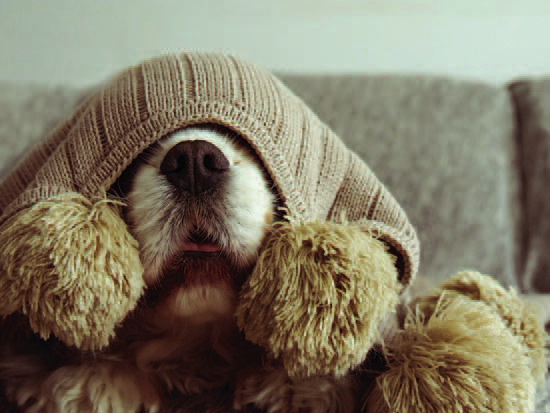
themselves trying to escape the noise, explained Cook. Alter - nately, if dogs are not confined to a small space, they may run ou or hide when frightened by the sounds.
In addition, the chemicals that help the fireworks explode and produce the colors that we see can be left behind in the fireworks' smoke, which, if inhaled, can irritate a pet's airway.
Cook pointed out, however, that the greatest danger do-it- yourself firework displays pose to our pets occurs before and after the explosion. "The biggest danger is with direct contact, when a pet may chew an unlit firework, grab a lit one, or touch hot materials after detonation," Cook said. "Those are pretty much the same concerns as you would have with small children and fireworks." If fireworks are used to cel ebrate the new year, all of the
firework debris should be picked up as soon as possible so that animals aren't exposed to the chemicals that contaminate the waste material.
Because there is no such thing as a safe firework when pets are around, Cook recommends owners leave their pets at home and go to a display organized by professionals to see fireworks for the new year.
"Do-it-yourself fireworks are a danger to you, your family, your pets, wild animals, and the environment," Cook explained. "The best thing to do is keep fireworks well away from pets." As a pet-friendly alternative to watching fireworks, Cook sug gests staying in as a family and taking precautions to minimize the light and sound of firework displays nearby, especially for pets that are known to be anxious. "Close the curtains and leave the lights on to minimize the euect of firework displays and have music or TV on to drown out the noise," Cook said. "It is helpful if the attending person is very matter-of-fact and does not make a big euort to reassure an anxious dog, as that reinforces a sense of danger." Some dogs may be more anx - ious than others, especially if they have a history of being very upset after hearing loud noises. If your pet is one that reacts negatively to loud noises and you live in an area where fireworks go ou consistently on New Year's Eve, Cook recommends talking to your veterinarian to determine if medication may help reduce your dog's anxiety.
"There are a lot of drugs that can safely be given by owners in the home environment," Cook said. "It would be worthwhile, how-ever, to try a dose at home on a routine weekend to assess the euect of the drugs." Cook also recommends pet owners familiarize themselves with recommendations from
The American Society for the Prevention of Cruelty to Animals ahead of any holiday celebrated
with fireworks. Whether it is watching fire - works or enjoying a night in on New Year's Eve, owners should make sure their pet is safe from potential dangers, so you and your furry friend can welcome the new year with ease.
Pet Talk is a service of the School of Veterinary Medicine & Biomedical Sciences, Texas A&M University. Stories can be viewed on the web at <vetmed. tamu.edu/news/pet-talk>. Suggestions for future topics may be directed to <vmbs-editor@tamu.edu>.