
How fast are we losing hardwoods in the Hill Country?
This column was originally written over 10 years ago, but the results are still valid and useful in terms of understanding our current woodlands. Note that the observations made back when this column was first written was several years BEFORE the severe freeze that killed and damaged so many trees and shrubs a couple of years ago.
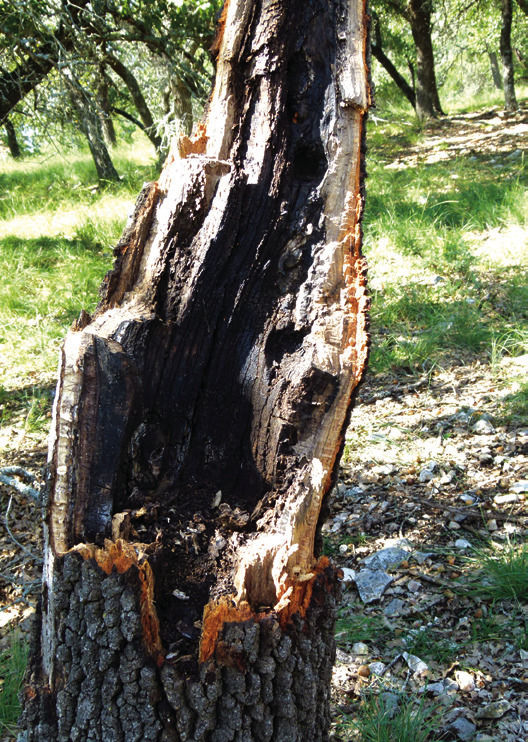
A few years ago, I noticed a large tree had broken off about six feet up the trunk out on the edge of our property. Upon closer inspection, I found that it was a blackjack oak about 18 inches in diameter and that, like many large Hill Country trees, it was hollow in the center. It got me to wondering, how many trees have we lost in the 10 years we have lived here?
So I spent some time walking the property counting dead trees that I knew had not been dead when we moved in about 10 years before. What I found was that we had lost 13 blackjack oaks, six post oaks, three live oaks,two and a half Spanish oaks and one shin oak for a total of 25 ½ mature oaks in an area of about 20 acres. That is over one mature hardwood lost per acre per decade.
The percentage loss of the different species is very different. We have more live oaks than any other species, so the three lost live oaks is a pretty small percentage (we don’t have oak wilt--yet). We have about equal numbers of blackjacks and post oaks, but we lost a lot more blackjacks. We only had four Spanish oaks when we moved in, so the loss of two and a half represents 63 percent of all of our Spanish oaks.
So what happened to these trees? Most died from either wind damage or a disease called hypoxylon, a fungus that appears to attack red oaks more often than any other trees. I could not determine what caused the deaths of some of the trees, but as best I can tell, all of the trees were lost to natural causes (wind, drought, natural diseases) and none were human caused.
So the questions are, is this normal, is it natural, and do we care? It is certainly at least somewhat normal, most all of these trees were probably at least 50 years old, and none of them would be expected to live forever. So, if it is a normal, natural phenomenon, then there is no reason for us to care, right? Well, maybe.
In a stable, mature ecosystem, a climax plant community should be replacing dead, diseased, and dying trees with young saplings that sprout either from seeds/ acorns or from mature tree’s roots. Only a small fraction of these young trees will grow to become mature, but enough will grow to maturity to replace the dying ones, and the forest community will be largely unchanged.
But guess what? In my survey looking for dead trees, I also looked for young sprouts and saplings. Except for a few places where I had built small cages to keep animals out, there were no baby trees, no toddlers, no teenagers and no young adults on the whole of the 20 acres. Except for one acre which has been enclosed in a deer-proof high fence for over 10 years! And in that one acre, the concentration of young trees is truly astonishing. In a brief walk, I counted over 57 young hardwood trees (mainly escarpment black cherries, hackberries and oaks) from one foot tall to over eight feet tall. I also counted 21 young shrubs and small trees including two 14-foot tall prairie flameleaf sumacs.
The only significant difference in that one acre is that there are no deer, no exotics and no livestock to browse these young trees. Thus, the natural processes of renewal and regeneration can still occur inside the high fence, and replacement trees are growing up.
It is true that before European settlers arrived in the Hill Country, there were significantly fewer trees, mainly because of the frequency of fires that killed a lot of the young trees, so we may be just beginning to go back to earlier numbers of hardwoods. However, the cause is no longer fires, but excessive numbers of deer, exotics and livestock, all caused by man. We have greatly increased the number of grazers and browsers, and the nature of the Hill Country is beginning to change as well.
So if you want to have replacements for dying trees, you need to cage any naturally occurring ones and plant new ones.
Until next time… Jim Stanley is a Texas Master Naturalist and the author of the books “Hill Country Ecology,” “Hill Country Landowner’s Guide” and “A Beginner’s Handbook for Rural Texas Landowners.” He can be reached at <jstmn@ktc.com>. Previous columns can be seen at <www.hillcountrynaturalist.org>, or at Riverside Nature Center at <https://riversidenaturecenter.org/ past-blogs-from-a-friend/>.