
Cottontails and Jackrabbits, It Wouldn’t Be Texas Without Them
Two of the remaining small mammals I have not yet discussed in these columns are the cottontails and jackrabbits. As a kid in West Texas, I could always find at least one or the other in a five-minute walk into the pasture. They are nowhere near that populous now.
Cottontails are rabbits, but despite the name, jackrabbits are not. Jackrabbits are hares. Rabbits are born naked, blind and almost helpless. Hares are born fully furred, eyes open and able to hop. Neither rabbits nor hares are rodents, they belong to the order Lagomorpha and the family Leporidae.
Three of the four species of rabbits in Texas have ranges that overlap in our part of the Hill Country, the Swamp rabbit (Sylvilagus aquaticus), the Desert cottontail (Sylvilagus audubonii), and the Eastern cottontail (Sylvilagus floridanus).
The Swamp rabbit is slightly larger than the other two with slightly longer ears. As the name suggests, it mainly inhabits areas along rivers and creeks or marshes. It very seldom ventures out in the daytime, unless flushed from its bed. All rabbits can swim, but this one is the only one to do so on its own without being chased. Its main range is from Kerr County eastward.
The Desert cottontail has very slightly longer ears, relative to its foot length, than the Eastern cottontail, a difference too slight to tell by simply watching the animal. Its main range is from Kerr and Gillespie counties westward.
Since telling the difference among these three in the field is very difficult, and since the most widespread rabbit in Texas is the Eastern cottontail, it is the only rabbit I will discuss further. The biology of all three rabbit species is very similar.
The Eastern cottontail is about 15-18 inches long and weighs from two to four pounds. It lives from one to three years in the wild, although the average newborn lives less than a year.
They are strictly herbivores, eating grass and other green plants from spring to fall and twigs and bark and other woody plants in winter. They are active at night, but also during the morning and evening, especially in winter.
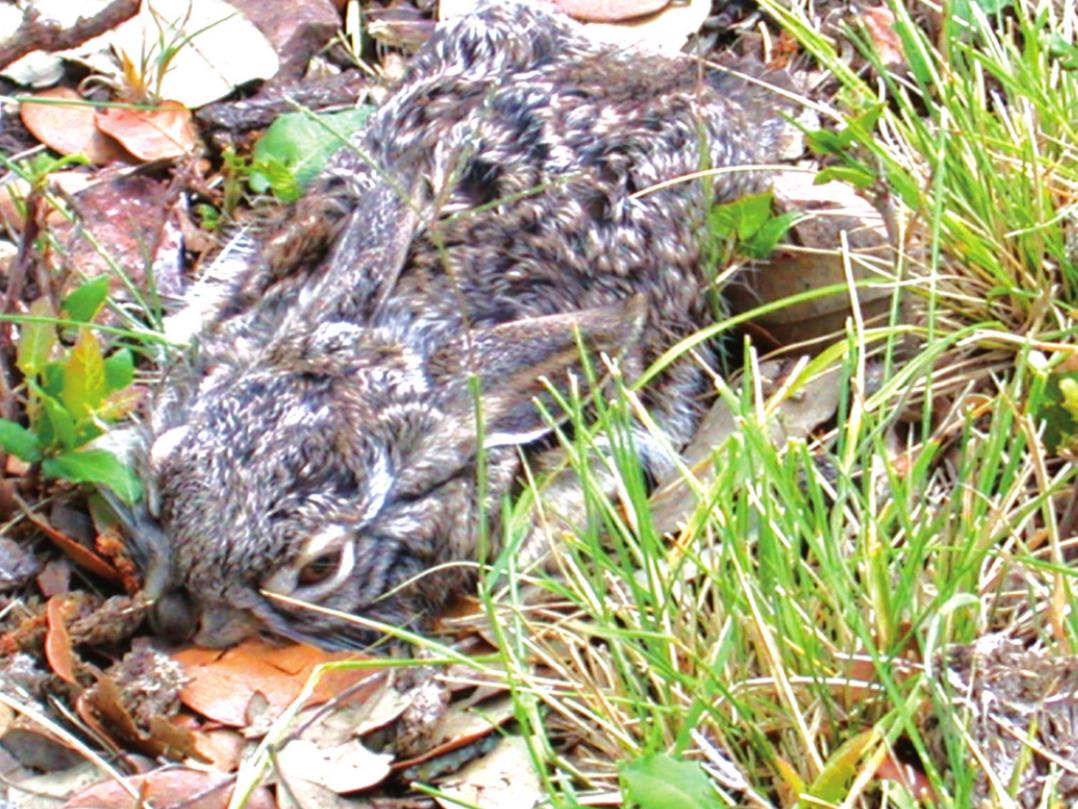
They can have as many as three to four litters a year, usually of three to six young. The mother makes a nest of leaves, lined with her chest fur and covered with other plant material. Usually, the mother only comes to the nest near dawn and dusk to nurse the young, otherwise she will not be at the nest. Unfortunately, many people find a nest and conclude that the mother “abandoned” it so they take the young to raise, usually with poor results. Once the young open their eyes and move about outside the nest, they are on their own. A four- or five-month-old rabbit is pretty much indistinguishable from an adult.
Cottontails are generally silent, but if attacked can emit a very loud piercing scream.
We have at times had a single cottontail living in or near our yard. On some occasions, it would approach us as if it were a pet, and if tossed a handful of sunflower seeds, it would gladly eat them, even with nice green grass all round.
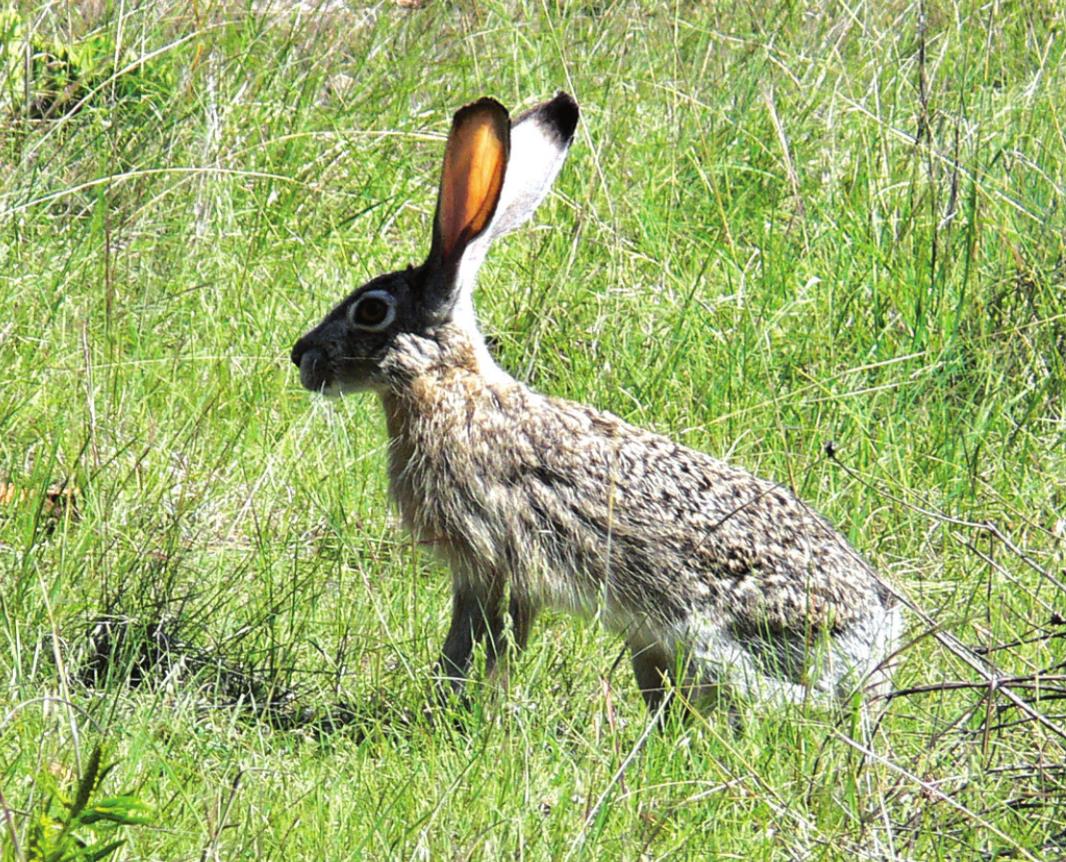
The Black-tailed jackrabbit (Lepus californicus) inhabits almost all of Texas except for the extreme southeast corner. They are 18 to 24 inches long and weigh from four to eight pounds. They have been known to leap as far as 20 feet and to run up to 45 miles an hour for short distances.
They eat mostly green plants, including many row crops, but will resort to twigs and bark in the winter. I have seen jackrabbits digging for shallow grass roots in the winter. Jackrabbits, like the cottontails, re-ingest soft fecal pellets to gain more nutrition from their food.
Jackrabbits usually have from two to six litters a year of one to six young. The nest is a minimal scrape in the dirt with some grass and fur added. The young are eating plants within two weeks and are weaned and completely on their own within four. Like the rabbits, the mother only comes back to the nest or to individual young for a few brief visits a day.
I have two more small mammals I want to discuss in a later column, porcupines and ringtails. Until next time…
Jim Stanley is a Texas Master Naturalist and the author of the books “Hill Country Ecology,” “Hill Country Landowner’s Guide” and “A Beginner’s Handbook for Rural Texas Landowners.” He can be reached at <jstmn@ktc.com>. Previous columns can be seen at <www.hillcountrynaturalist.org>, or at Riverside Nature Center at <https://riversidenaturecenter.org/past-blogs-from-a-friend/>.