
The most detrimental, invasive, exotic plants of our area
I have written in the past about the problems caused by invasive exotic species, both plant and animal. Worldwide, invasive species are responsible for more native species extinction than any other cause, except for human “development.”
Invasive exotic species crowd out native species without replacing the function our native species had in the habitat, thus not only displacing native vegetation but the animals that depended on them, as well as reducing the productivity and carrying capacity of our native habitats.
Below are what I believe to be the three most damaging exotic invasive plants in the Hill Country.
The Chinaberry tree (Melia azedarach), is a large deciduous tree with a trunk up to two feet in diameter. It has dark green lacey bipinnately compound leaves up to two feet in length with one- to two-inch long leaflets which can have nearly smooth or deeply-toothed margins. It produces clusters of pink or purple flowers in the spring. The fruit are hard yellow berries that may persist throughout the winter. These berries are poisonous to goats, hogs and humans. Note: In some parts of Texas, unrelated, native western soapberry trees are called “wild chinaberries.”
Chinaberry trees are native to Asia and were introduced into the U.S. in the 1800s. They are fast-growing and can reproduce when only shrub size so they can form thickets crowding out native vegetation.
In our area, Chinaberries are most common in riparian areas (bottomland along creeks and streams), but individual trees can be found just about anywhere. They are numerous along all of the creeks that flow into the Guadalupe, as well as along the river itself.
Control methods include repeatedly cutting all new sprouts (once is never enough as it will re-sprout from the roots) or cutting and immediately painting the cut stump with Rodeo herbicide. Note: Rodeo is approved for application in riparian areas; most other herbicides are not. Use only as little herbicide as necessary to soak the cut stump surface.
Ligustrum or Japanese privet (Ligustrum japonicum) is a very common large shrub, usually with multiple trunks, that grows up to 20 feet tall. Its simple twoinch leaves grow in an opposite arrangement along the stem. The leaves are oval-shaped with a pointed tip, dark green, smooth and somewhat stiff with smooth margins. The above characteristics, plus all leaves looking identical, sometimes gives the appearance of an artificial, plastic plant.
Ligustrum forms clusters of white blooms in late spring or summer and produces purple berries in the fall. It tends to form dense thickets which result from either root sprouts or from seeds dispersed by birds. It frequently grows in the shade along riparian areas, but can be found almost anywhere. It is especially common is yards in town, where it is not controlled. Japanese privet is a native of Japan, but there are related species, Chinese privet, Glossy privet, and Wax-leaf Ligustrum.
Control methods are the same as for chinaberry above.
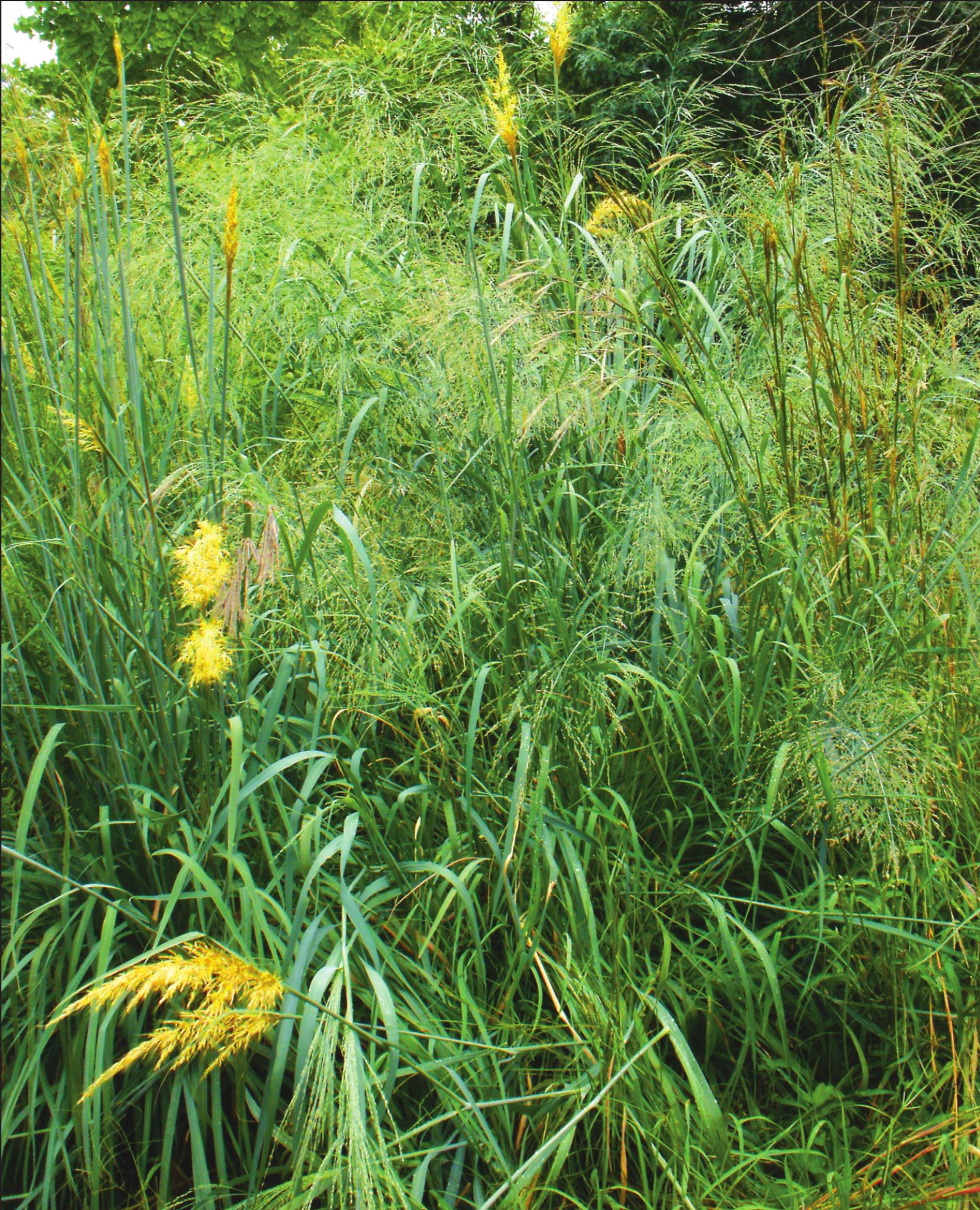
Giant reed (Arundo donax), is not a reed but a grass that can grow to 20 feet tall! It has twoinch wide leaves and a fluffy seed head in late summer. It is usually seen around here in riparian areas along our creeks where it forms dense stands covering large areas crowding out most other native vegetation and destroying habitat for native animals.
Its reproduction is mostly vegetative, either sprouting from rhizomes (underground roots just below the surface) or from brokenoff pieces that float downstream and lodge somewhere and take root. It is because of this latter characteristic that mechanical methods of control are not recommended as they just spread the grass downstream. Control of this invasive is recommended by cutting the stalk, hauling it off or burning it. You may also get help from the Upper Guadalupe River Authority.
Of course, my selection of these three species was somewhat subjective, and where you live there may be other species that are causing a problem. Here is a partial list of other problem exotics: Chinese tallow, Vitex (Chaste tree), Bamboo, Musk thistle, Water hyacinth, Tree of Heaven and Nandina (Heavenly bamboo). Some invasive grasses that many folks have to deal with include Bermudagrass, Johnsongrass, and KR bluestem.
If you don’t have any exotics on your place, you are lucky, but be vigilant, as they can sprout up almost anywhere. Whatever you do, don’t buy any of these exotics. If you see something for sale that you have never heard of before or never seen, be skeptical.
Until next time…
Jim Stanley is a Texas Master Naturalist and the author of the books “Hill Country Ecology,” “Hill Country Landowner’s Guide” and “A Beginner’s Handbook for Rural Texas Landowners.” He can be reached at <jstmn@ktc.com>. Previous columns can be seen at <www.hillcountrynaturalist.org>.