
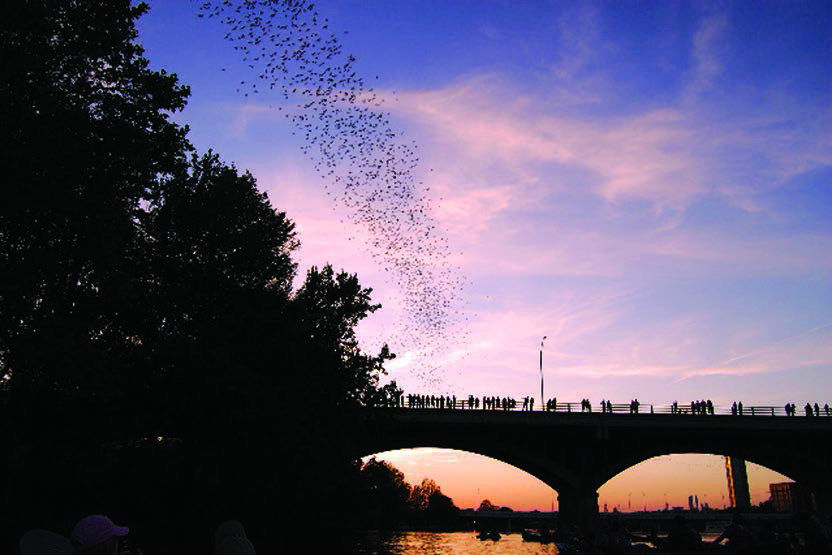

Gather the flashlights, put on those costumes, and look to the night skies: Halloween has arrived. Across the Lone Star State, spooky season is in full swing with glowing pumpkins and children dreaming of their candy hauls after a night of trick-or-treating. But that is not all Texas has to offer during this festive holiday: deep in the heart of our state’s capital lies a bridge that is home to some familiar Halloween faces.
Just south of the Texas Capitol in downtown Austin, the Ann W. Richards Congress Avenue Bridge is the home to the largest urban bat colony in the world, with an estimated 1.5 million bats. The bridge is a maternity colony and hosts a mainly female population that raises an estimated 750,000 pups each year. These Mexican free-tailed bats migrate each spring from Mexico and CentralAmerica to numerous spots across the southwestern United States, but they always seem to return home to Austin.
The bats aren’t the only one who make this pilgrimage. Texans and others from around the world travel to the bridge every year to see the spectacle, making it one of Austin’s most famous tourist attractions. In fact, it brings in nearly $10 million in revenue every year from around 140,000 bat-loving visitors.
I was wondering - and I’m sure as some of my fellow Texans are, too - how and why did these creatures come to call Austin their home? It all started following the revamping of the Congress Avenue Bridge in the early 1980s. While the Texas Department of Public Safety was working on construction, they had no idea they would be creating the ideal home for more than a million of these spooky little critters.
The bridge renovations included ¾-inch to one-and-ahalf- inch concrete beams, with 16 to 18-inch crevices separating them. It just so happens that our winged mammal friends need dark, warm, narrow places to rest during the day, so this unintentionally became the perfect place to hang out - pun intended!
Not only is October known for Halloween, but in Austin, it is the end of the bats’ time in Texas for the year before they make their trek back down to Mexico and Central America. Bat season typically runs from early March to the end of October, with some stragglers remaining until the beginning of November.
These furry, flying flittermice were not widely accepted amongst Austinites when they first arrived, and many wanted them to be exterminated for fear of them spreading disease. Some Texans went so far as to sign petitions, with newspaper headlines reading, "Bats Sink Teeth Into City," and the local paper even described a “Mass Fear in the Air as Bats Invade City.”
As this was happening, conservationist Merlin Tuttle stepped in, advocating to save the Austin bats. Tuttle met with local city officials to preach how the bats were beneficial to the community as they each eat thousands of insects, which helps to protect agriculture around the area. Some would say they act as free pest control, perhaps in exchange for rent under their beloved Congress Avenue Bridge.
The bridge isn’t the only place to see bats, however. The Austin American-Statesman’s Bat Observation Area, Butler Hike & Bike Trail, or even taking a riverboat ride on Lady Bird Lake all put you front and center to watch the Count Flap-ulas emerge during the night.
For those who are just batty about bats, Austin is also home to Bat Fest, which just celebrated its 20th anniversary in September and brings together Austin culture, bat-themed activities, and a group viewing to watch the nearly 1.5 million bats emerge from their lair under the Congress Avenue Bridge to fetch their meals for the night.
Halloween may be the one night of the year when neighborhoods light up with glowing jack-o’-lanterns, sweet treats, and giggling ghosts. But the bats so fondly associated with the holiday also seem to bring a little festive spirit throughout the entire summer and fall for Austinites as our furry, flying friends call our state’s capital their home.
Senator John Cornyn, a Republican from Texas, is a member of the Senate Finance, Judiciary, Intelligence, Foreign Relations, and Budget Committees.