
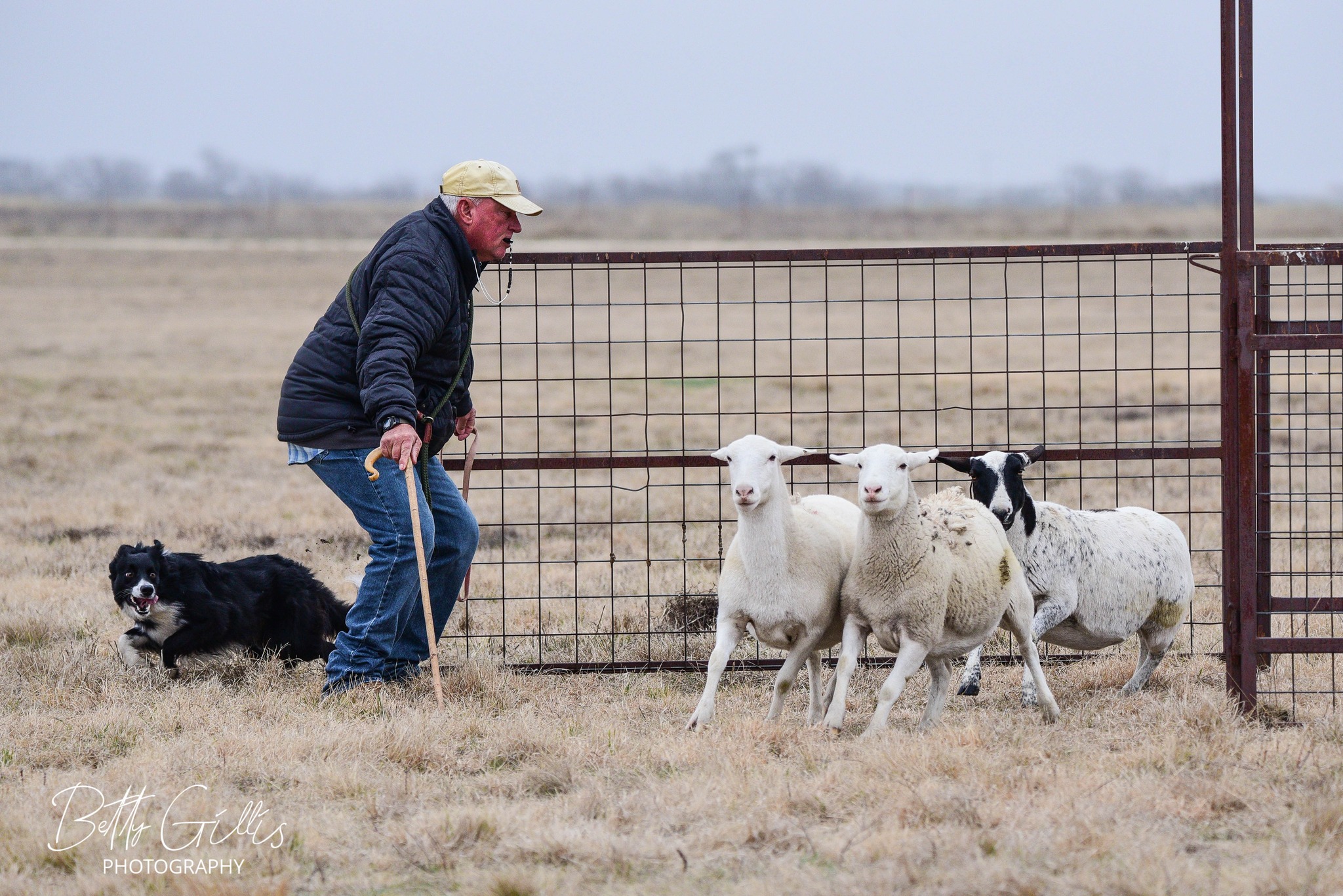
Sheep Dog trials began in Great Britain in the late 1800’s as competitions among farmers to evaluate which dogs were best at the work they performed daily on the farm. Modern trials continue that tradition, but in a structured format that judges the dogs’natural abilities and the partnership with their handler. The layout of the trial courses from way back then was so well thought out, that it remains nearly identical in today’s sheep dog field trials.
The Gather
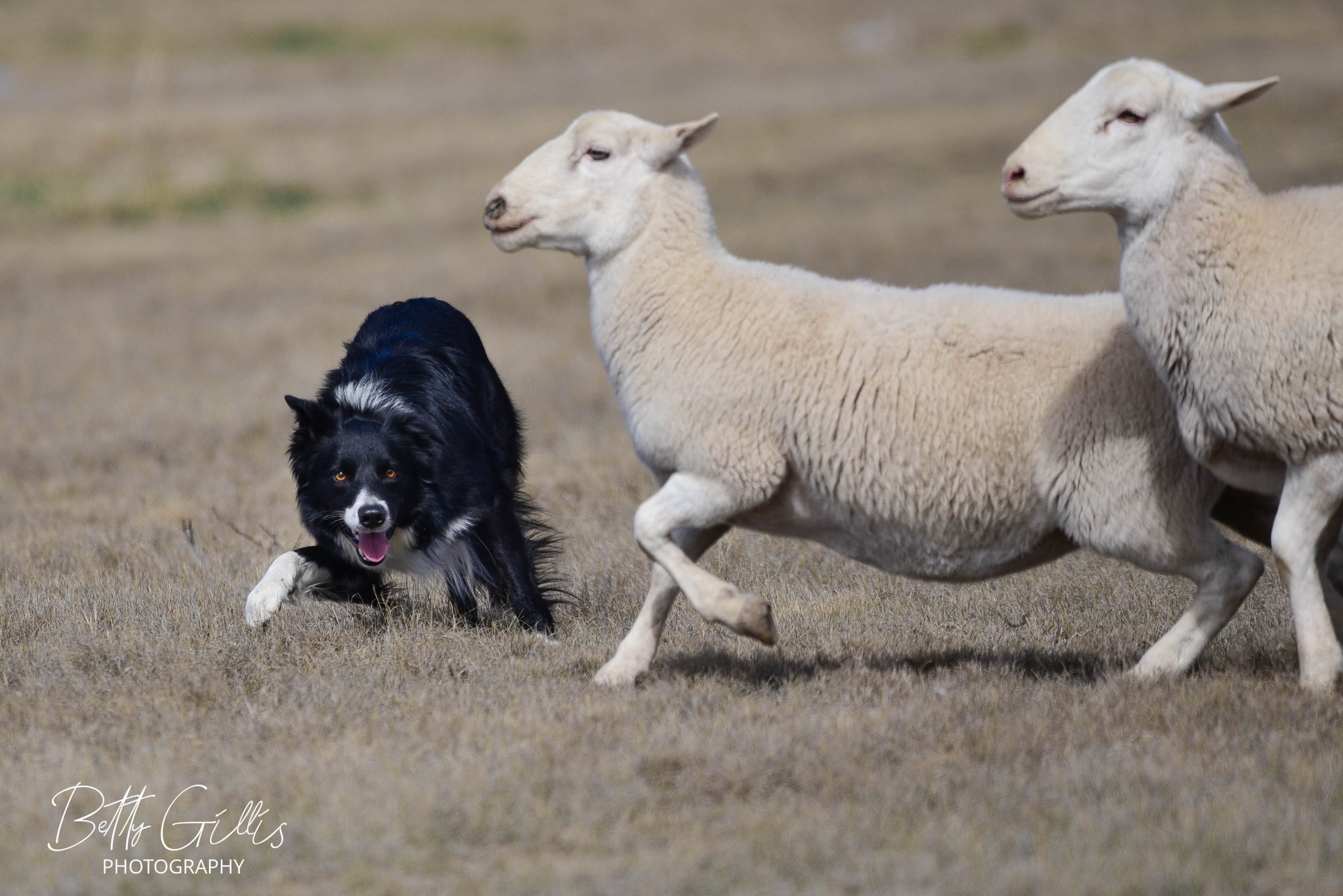
The most important and natural skill in a well-bred working Border Collie is called the “gather.” This involves the dog going out in a curved, “pearshaped” track to get behind the sheep without disturbing them, and then to “lift” them to get them moving, and then to “fetch” the sheep (bring) in a more-or-less straight line back to the handler. Even young puppies will exhibit this natural skill behavior that is bred into the working Border Collie. In a farm or ranch situation, the gather may vary depending on the distance, terrain and obstacles encountered, such as gates, fence lines, trees, tanks, streams, etc.
The method that the Border Collie uses to lift the sheep will depend upon the number of sheep and how spread out they may be.
At a sheep dog trial, just as on the farm, the outrun may start on the left or right side and varies in distance and terrain. In a trial situation the field tends to be more open and encouraging of the natural and instinctive outrun style of the well-bred working Border Collies.
The Lift
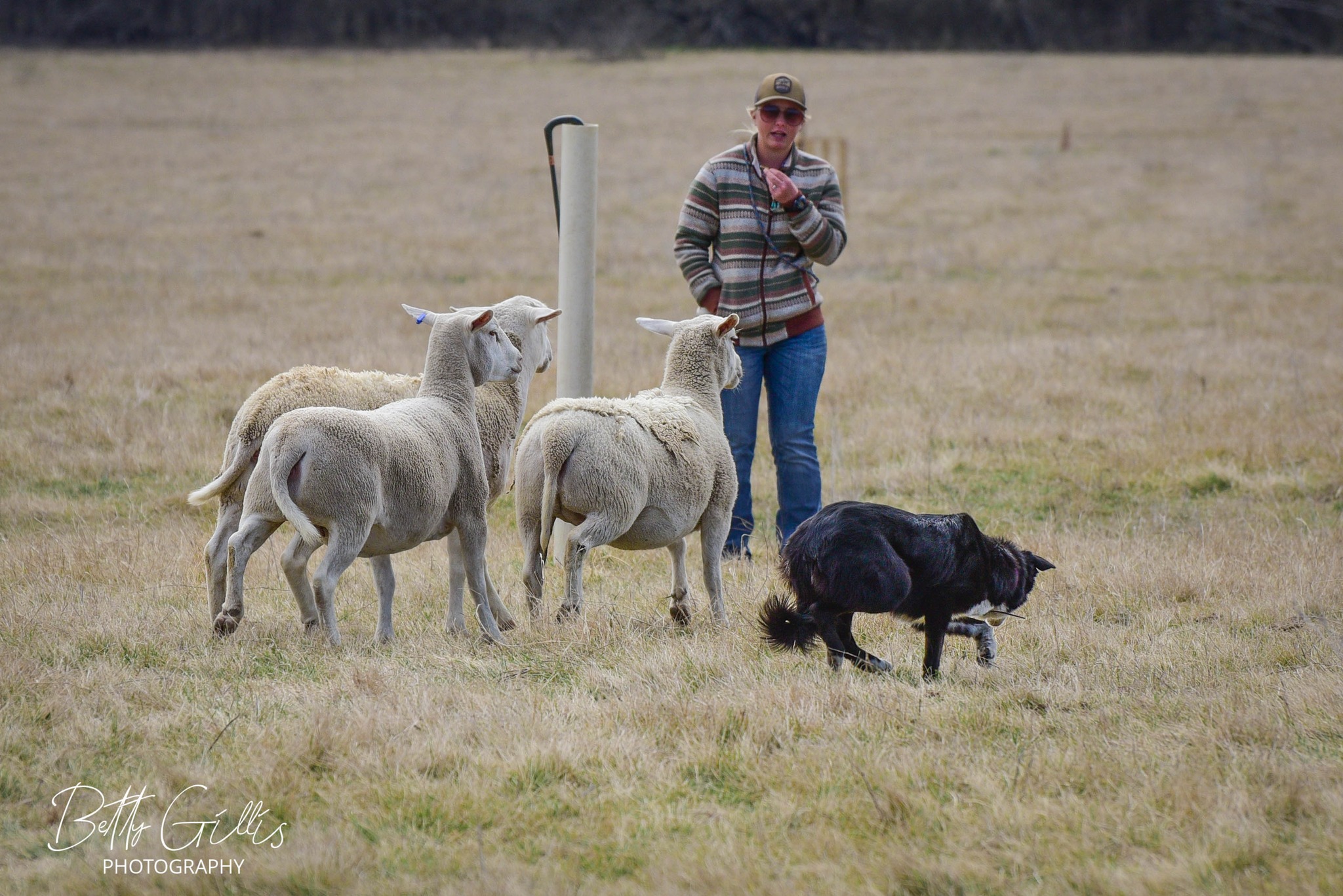
At trials, the dogs work on smaller packets of 3-5 sheep, so the “lift” is more direct and straightforward than when gathering larger flocks that are spread out in a field. Sheep in a smaller packet tend to feel more vulnerable and are therefore more challenging for the Border Collie to control. At a trial, the sheep are “set out” (held) in approximately the same location for each handler and dog team. Other dogs, people and sometimes horses are used to hold the sheep packet at the set-out. This set-out can be anywhere from a few hundred yards up to six or eight hundred yards!
The Drive
The fetch is judged on how efficiently the sheep are brought on a designated path . . . usually a straight line and through a set of “fetch gates,” continuing straight to the handler’s feet, where the dog and handler work together to “turn” the post. The dog and handler work closely together as a team with precise whistle communications to assure the sheep stay on the correct path down the fetch, through the fetch gates and around the post.
The drive starts after the sheep have turned the post. This is the most unnatural aspect of the work that a Border Collie is asked to do. The handler and the dog continue to work closely together as the dog is instructed to drive the sheep away from the handler, in a straight line, and through another set of drive-away gates. Then the dog is instructed to turn the sheep and drive them in a cross-drive direction across the trial field and through another set of cross-drive gates. Once the plane of the crossdrive gates has been cleared (hopefully with the sheep going through the gates), the Border Collie then “fetches” the sheep back to the center of a 40-foot diameter shedding ring that is marked on the ground in front of the handler’s post. The handler can leave the post and join the dog and the sheep once the first sheep steps into the shedding ring.
The Shed
Depending upon how many sheep are in the packet, the dog and handler will have been instructed by the judge to “shed off” or (separate) one or two of the sheep. The dog must come into the middle of the sheep when the handler calls it in, and it must take control of the shed off sheep and prevent them from rejoining the rest of the packet. This maneuver is a highly skilled one that top-level dog/ handler teams can perform with quiet power.
The Pen
After a successful shed, the sheep are regathered in a workmanlike manner and are then “penned” nearby. It is important to note at any time during the run, that “gripping” (biting) is an automatic disqualification, unless a dog is defending itself from an aggressive sheep.
Time Allotment and Points Each run has a set time for completion, and a dog / handler team begins their run with all their allotted points. A skilled judge watches each run and will deduct points for mistakes such as a crooked “lift,” being offline, missing a set of drive gates, a wide turn at the post, a “messy” shed, circling the pen, etc. If a dog and handler run out of time before completing all the course, they keep the points they have accumulated up to that point. In the end, the “winner” is the dog / handler team with the most points. Ties are determined by the highest scores on the outrun, lift and fetch.
See you There!
This year the judge is Miss Nataly Matthews from Wales. She will be judging the sheep dog team competitions all day, beginning on Friday, March 6th, and ending on Sunday afternoon, March 8th. Location: 510 TX-16 just south of San Saba . . . watch for the banners on the fence and follow the road into the Kirk ranch. Admission is free. Dress for the weather! Consider bringing a lawn chair and maybe a pair of binoculars to be able to see the distance work better. The city will set up the bleachers and the big tent up on top of the hill so spectators will have a great spot to watch all the action on the field.