

There are 10 species of squirrels in Texas, with three species listed as residents of the Hill Country. Of the 10 species, three are classified as tree squirrels, and seven are classified as ground squirrels, which also includes chipmunks and the black-tailed prairie dog. The latter was once here but has long since been extirpated.
Our three Hill Country squirrels include two ground squirrels, the Mexican ground squirrel (Spermophilus mexicanus) and the Rock squirrel (Spermophilus variegatus) and one tree squirrel, the Eastern fox squirrel (Sciurus niger). The other ground squirrels primarily inhabit Western Texas, while the other two tree squirrels, the Eastern gray squirrel (Sciurus carolinensis) and the Southern flying squirrel (Glaucomys volans) dwell in East Texas. All of these critters are in the order Rodentia and the family Sciuridae.
The Mexican ground squirrel is a small chipmunk-like animal with nine rows of square white spots along its back. I know they are supposed to live here, but I have never seen one anywhere east of Junction, so I won’t discuss them further.
By far, the most common squirrel in the Hill Country is the Eastern fox squirrel, the one we all see almost everywhere. Its body is about a foot long and its tail is almost the same, and they weigh from one to two pounds. Its back is gray, but its belly, chest and the sides of its legs are rusty orange, and its tail may be a mixture of gray and orange. There is a rare black morph, but I have never seen one here.
Fox squirrels live from two to five years in the wild. If available, they prefer to nest and den in hollow trees and in the winter may have communal dens. If no suitable hollow trees are around, they may build nests of twigs and leaves, especially in summer, which can be up to about two feet in diameter.
They sometimes have two litters in a year: one in March or April and another in August or September. They usually have two to four young per litter. The young leave their mother and are on their own in about three months.
Fox squirrels are largely vegetarian, their main food being nuts, acorns, buds, seeds and green shoots, but have been known to also take birds eggs and insects. We have all watched squirrels burying acorns, especially in the fall when more acorns are falling than they can eat. I have heard many people wonder whether they ever find the nuts or acorns they bury—the experts claim they find them by smell, not by remembering where they buried them.
Fox squirrels, like most of their relatives, are diurnal, meaning they are active during the day, but unlike many animals, they don’t usually become active until a few hours after sunrise—they may be the only animals that sleep later than I do!
I consider our Fox squirrels the most entertaining animals to watch. They are extremely agile and flexible. Have you ever watched one walk a telephone line to cross a road? They can climb a tree 30 times their body length in a matter of a couple of seconds! They are also capable of complex problem solving whenever we humans put out bird food where we think they can’t get to it.
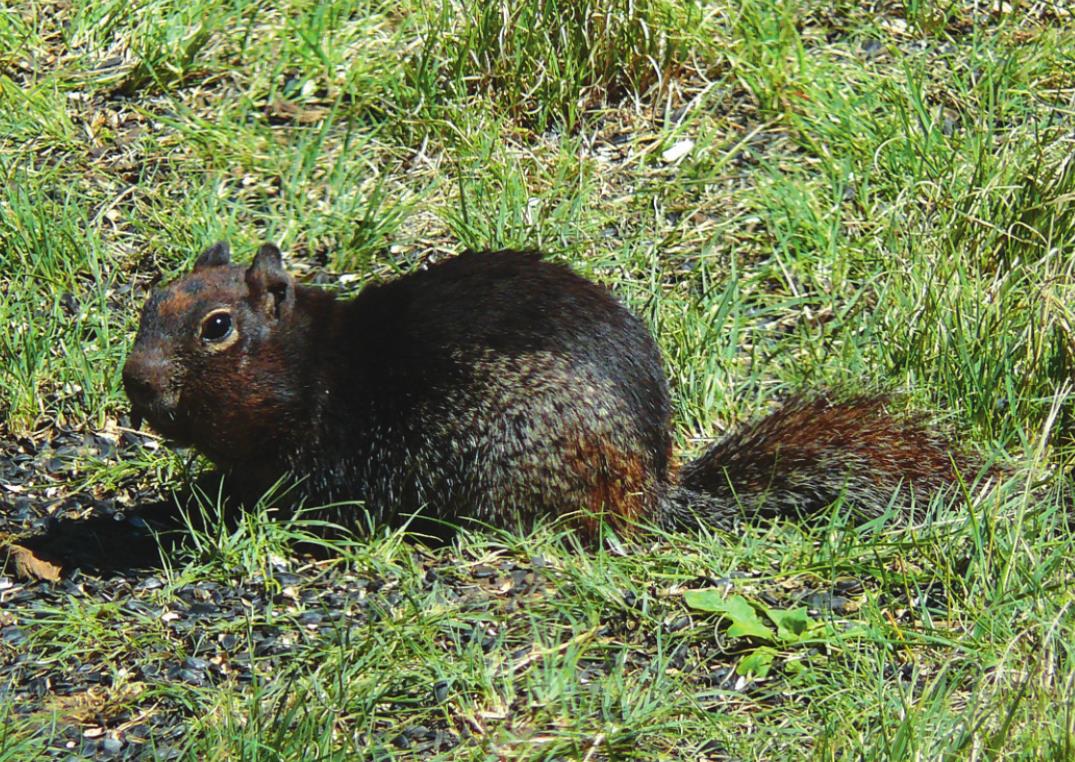
The Rock squirrel is a ground squirrel, but one capable of climbing trees almost as well as the Fox squirrel. They are larger than most other ground squirrels, almost as large as the Fox squirrel. All the ones I have seen in this area have a head and the front part of their body very dark gray or black, with the hind part of the body lighter colored and somewhat mottled. In other areas, they are considerably less dark than the ones around here.
They like rocky areas and den in a burrow they dig, usually under a rock. Rock squirrels typically have three to nine young, once a year. They are omnivorous, eating green plants, seeds, nuts, fruit, insects, and bird eggs. They hibernate in this area for the coldest months.
I have observed one scavenging sunflower seeds from under our bird feeder and filling his cheek pouches, then coming up on the porch and eating his collection, then repeating this several times. When it is really hot out and the concrete porch floor is cool, he will sometimes lay out spread-eagle to cool off.
Until next time…
Jim Stanley is a Texas Master Naturalist and the author of the books “Hill Country Ecology,” “Hill Country Landowner’s Guide” and “A Beginner’s Handbook for Rural Texas Landowners.” He can be reached at <jstmn@ktc.com>. Previous columns can be seen at <www. hillcountrynaturalist.org>, or at Riverside Nature Center at <https://riversidenaturecenter. org/past-blogs-from-a-friend/>.