


A popular topic of conversation in rural Texas coffee shops is rain, specifically “How much did you get?”. Texans anticipate those life-giving droplets and value them as highly as gold. But some Texans take it a step further and save that gold like money in a bank.
John and Jayne Davis, proud owners, and diligent stewards of Pecan Spring Ranch in Menard County, invited the staff of the Hickory UWCD to their place to see their new rainwater harvesting system. John Davis, a former Texas State Representative for District 129 (Houston) from 1998 until 2015, is a fifth generation Texan with deep roots in Menard County. The ranch has been in his family since 1880 when his great-great grandparents, German immigrants, Johann and Johanna Wilhelm, settled there.
Committed to the restoration of natural habitat, the Davis family, with the help of ranch supervisor Elo Heyman and the guidance of the experts at Native American Seed in Junction, has worked to re-establish native grasses on the property. Proponents of water conservation, the family is installing an elaborate and efficient rainwater harvesting system on the property to support the restoration efforts.
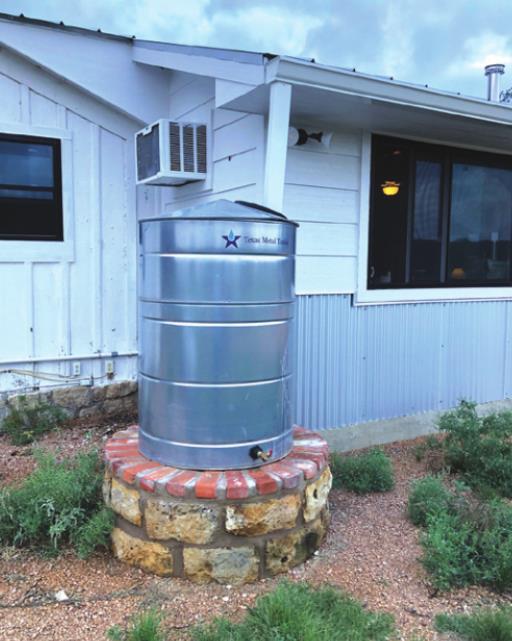
Two small stainless steel storage tanks fed by gutters flank the ranch house, providing water for the drought tolerant landscape. This system is just a teaser though. The main project is the 8,000 square foot 120-year-old barn. To demonstrate the tremendous amount of water a roof this size can capture, one need only put pen and paper (or calculator) to work. One inch of rain falling on this roof would equal 4,984 gallons of water. The formula used is:
Roof Area (ft2) X Precipitation Amount (in) X 0.623 = Amount Collected (gallons)
In an “average” year, local rainfall amounts hover around 24 inches. At this rate, the Davis family could collect 119,616 gallons of water. Even in 1954 when the area received less than nine inches, 44,856 gallons could have been accumulated. According to the USGS, the average person in the US uses about 80-100 gallons a day, so the water collected in a drought year could more than meet the needs of an individual not even attempting to conserve water.
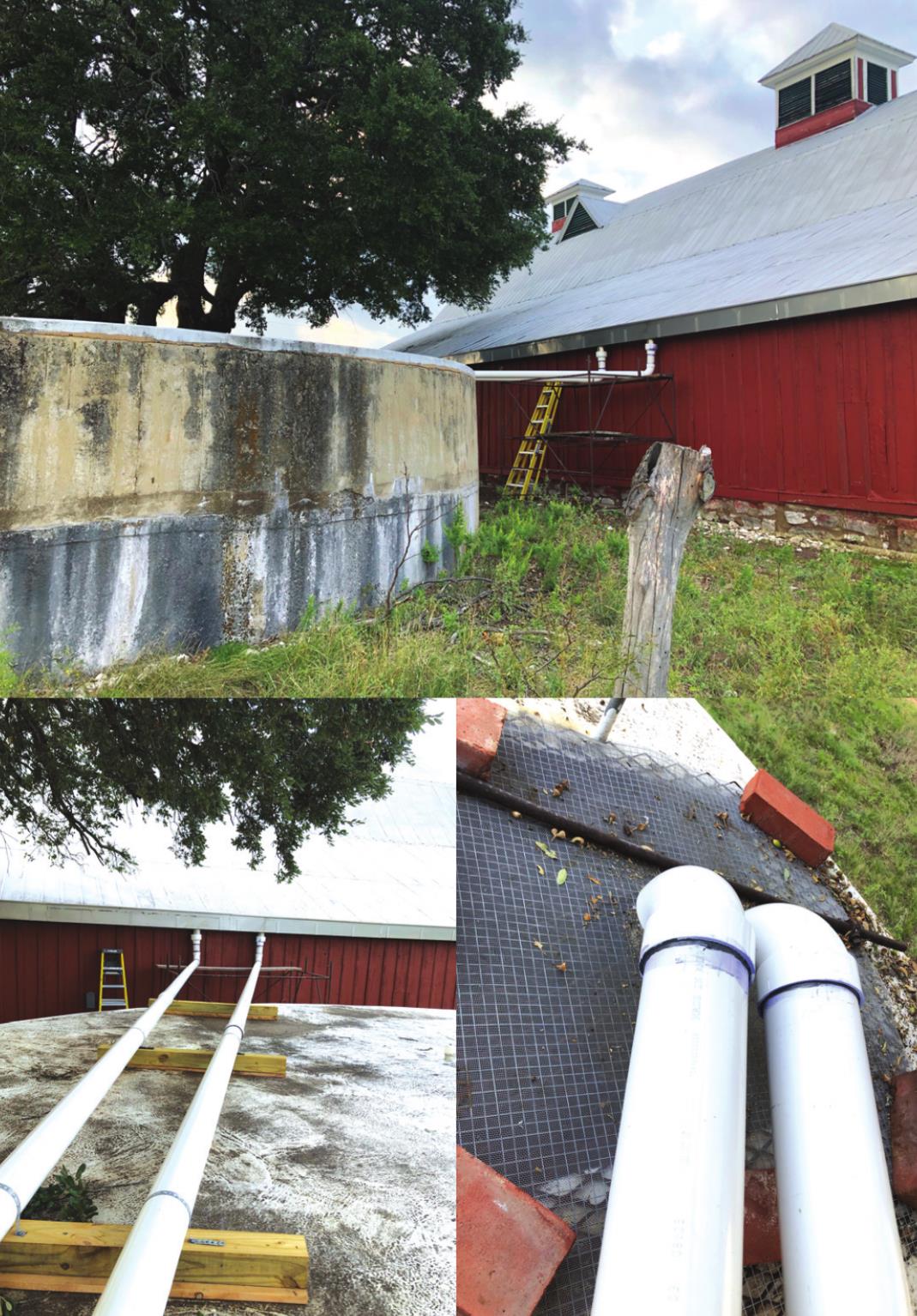
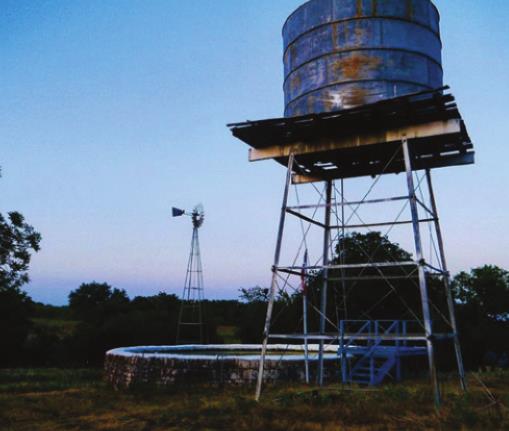
Quite a bit of work went into the barn’s transformation. Metal roofing replaced the old roof, and box gutters were installed on both sides of the large building. On one side, a stainless-steel tank captures the rainfall. On the other side, the water is diverted into a cement tank capable of holding at least 25,000 gallons. Overflow from this tank is routed to a natural reservoir which once caught the flows of a spring. Unfortunately, the spring is now dry. A hundred yards away, a windmill feeds an elevated water storage tank and reservoir. This second system will also divert overflow to the natural holding area.
By installing the system, the Davis family reduces their dependence on well water. This not only lessens the impact on local aquifers, but it also pays for itself over the long run. In drought prone Texas, any methods of conservation are applauded and encouraged. If you are interested in rainwater harvesting, the district has FREE manuals available. Just contact the office at 325-597-2785 or email <hickoryuwcd@yahoo.com>. TWDB also has a free downloadable booklet you can find at <https://www.twdb.texas.gov/innovativewater/rainwater/doc/RainwaterHarvestin gManual_3rdedition.pdf>.