
Some Hill Country Trees and Shrubs of the Legume Family

Previously, I wrote about the interesting and important Legume or Pea family of plants. Plants in this family produce seeds in “pods” like beans or peas. Most are capable of “fixing” nitrogen from the air to use by the plant, and most have compound leaves (leaves made up of numerous smaller leaflets frequently arranged in pairs on opposite sides along a stem).
Here are a number of the more common Hill Country native trees and shrubs that belong to that family.
There are many species of Acacias, including Huisache (Acacia farnesiana), a large shrub or small tree with tiny leaflets, long thorns in pairs at the leaf nodes and ½-inch golden-yellow spherical flowers in the spring. Roemer acacia or Catclaw acacia (Acacia roemeriana), is a shrub with small, rounded leaflets, short curved thorns, and cream-colored ½-inch balls on red stems in the spring. There are several other acacia species, most of which are more common to the south and west of here.
Anacacho orchid tree (Bauhinia congesta) grows on the western part of the Edwards Plateau. It is a shrub to small tree with two ½-inch leaflets attached to the end of a petiole and ¾-inch wide five-petal white flowers in spring.
Black dalea (Dalea frutescens) is a low (one to three feet) rounded bush with gray-green leaflets and bright purple flowers from summer to fall.
Eve’s necklace (Sophora affinis) is a small tree with one-inch long oval leaflets. It has pink pealike flowers in early spring and the seed pod is constricted between seeds giving the appearance of a “necklace.” It makes a nice, airy landscape tree.
False indigo (Amorpha fruticosa) is usually a multi-stem shrub growing in shade near creeks. It has one-inch oblong leaflets and puts up two- to six-inch long flower spikes composed of many tiny purple flowers.
Golden-ball lead-tree (Leucaena retusa) is a small tree with ¾-inch elliptic leaflets and bright yellow one-inch spherical blooms in the spring. It grows in areas just slightly west of here and also makes a good landscape tree.
Kidneywood (Eysenhardtia texana) is a thorn-less multi-trunk shrub with tiny leaflets. It puts up small white blossoms that the bees love on flower stalks at the end of branches. It is a favorite of deer.
Our native mimosa is Fragrant mimosa or Pink mimosa (Mimosa borealis) which is a low multibranched shrub. It produces ½-inch pink round balls in early spring and small flat pea-like pods. This shrub has many short prickles along its branches.
Probably the most well-known legume in Texas is the Mesquite or Honey mesquite (Prosopis glandulosa). Because it can be invasive under certain conditions in certain areas, it is often considered to be a nuisance. However, in moderate density in many places, it is a valuable tree providing nectar for bees and highly nutritious beans for livestock and wildlife. In much of the Hill Country, the soil is too shallow for mesquite to grow well. Its flowers are yellow-green clusters on long drooping spikes.
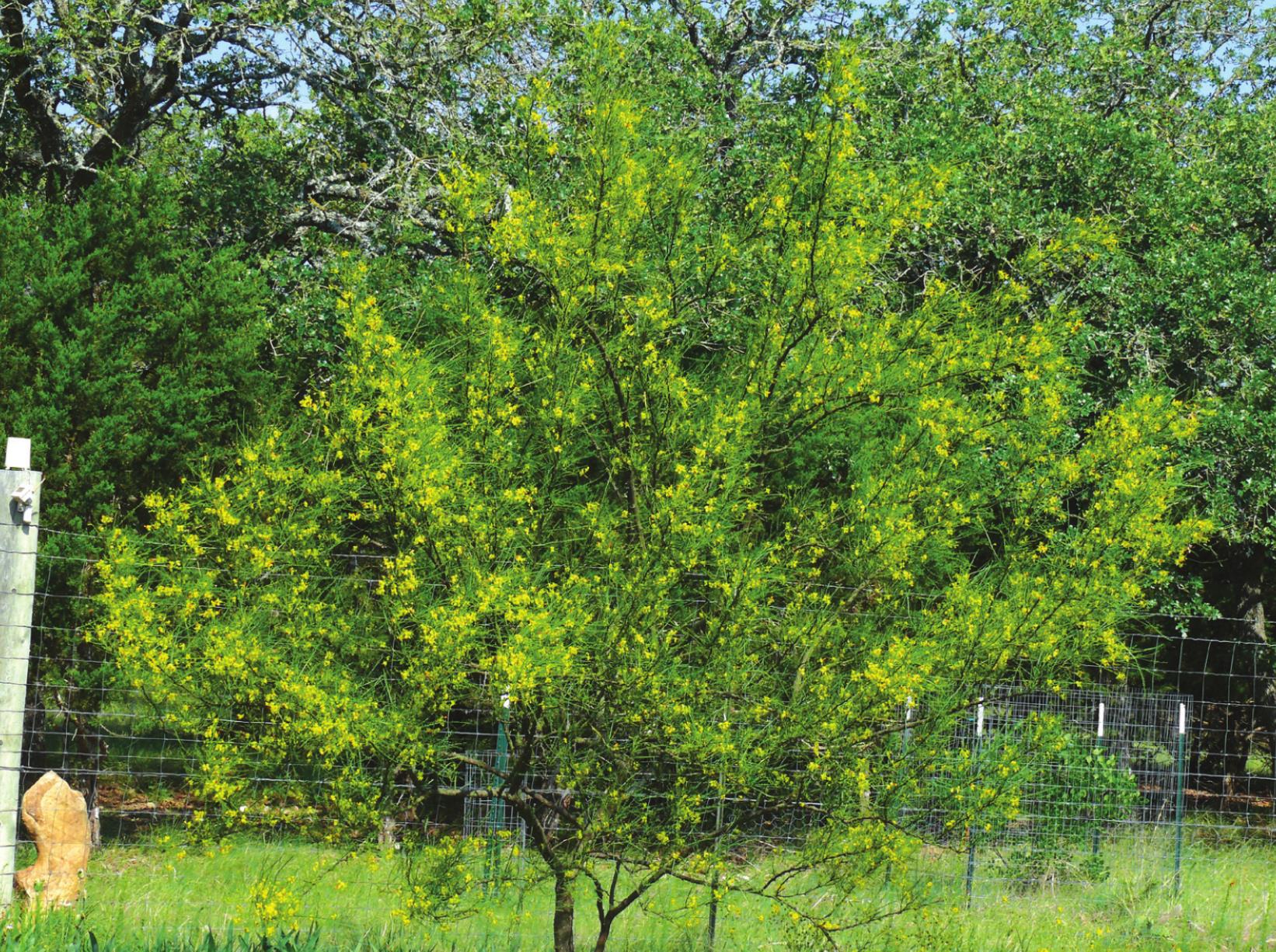
Retama (Parkinsonia aculeata) is a small tree or large shrub with unique foot-long leaves sporting tiny leaflets. At the base of each leaf are small sharp thorns. In drought times, the retama will drop its leaves and then grow them back after rains. The bark is smooth and green and can carry out photosynthesis like leaves. It blooms throughout the spring and summer, especially after a rain, with bright yellow flower clusters.
Texas mountain laurel or Mescal bean (Sophora secundiflora) is a stunning evergreen shrub or small tree with shiny, dark-green oval leaflets one to two inches long. It blooms in early spring with large showy clusters of purple-blue pealike flowers which smell like grape Kool-Aid! The leaves and seeds of this plant are toxic to livestock and humans if ingested. Deer seldom nibble this plant.
Texas redbud (Cercis canadensis var. texensis) is a showy small tree with two- to three-inch simple leaves that are heart-shaped to round (this is the only Legume discussed here that does not have compound leaves). It produces pink blooms before or at the same time as the leaves are emerging in the spring. This is a popular landscape plant that grows well, but be certain you are not buying an Eastern redbud which will not do well here.
The above is just a small fraction of the total number of woody leguminous plants known in Texas.
Come visit me on Fridays from 10 to 12 at Riverside Nature Center.
Until next time…
Jim Stanley is a Texas Master Naturalist and the author of the books “Hill Country Ecology,” “Hill Country Landowner’s Guide” and “A Beginner’s Handbook for Rural Texas Landowners.” He can be reached at <jstmn@ktc.com>. Previous columns can be seen at <www.hillcountrynaturalist.org>.