
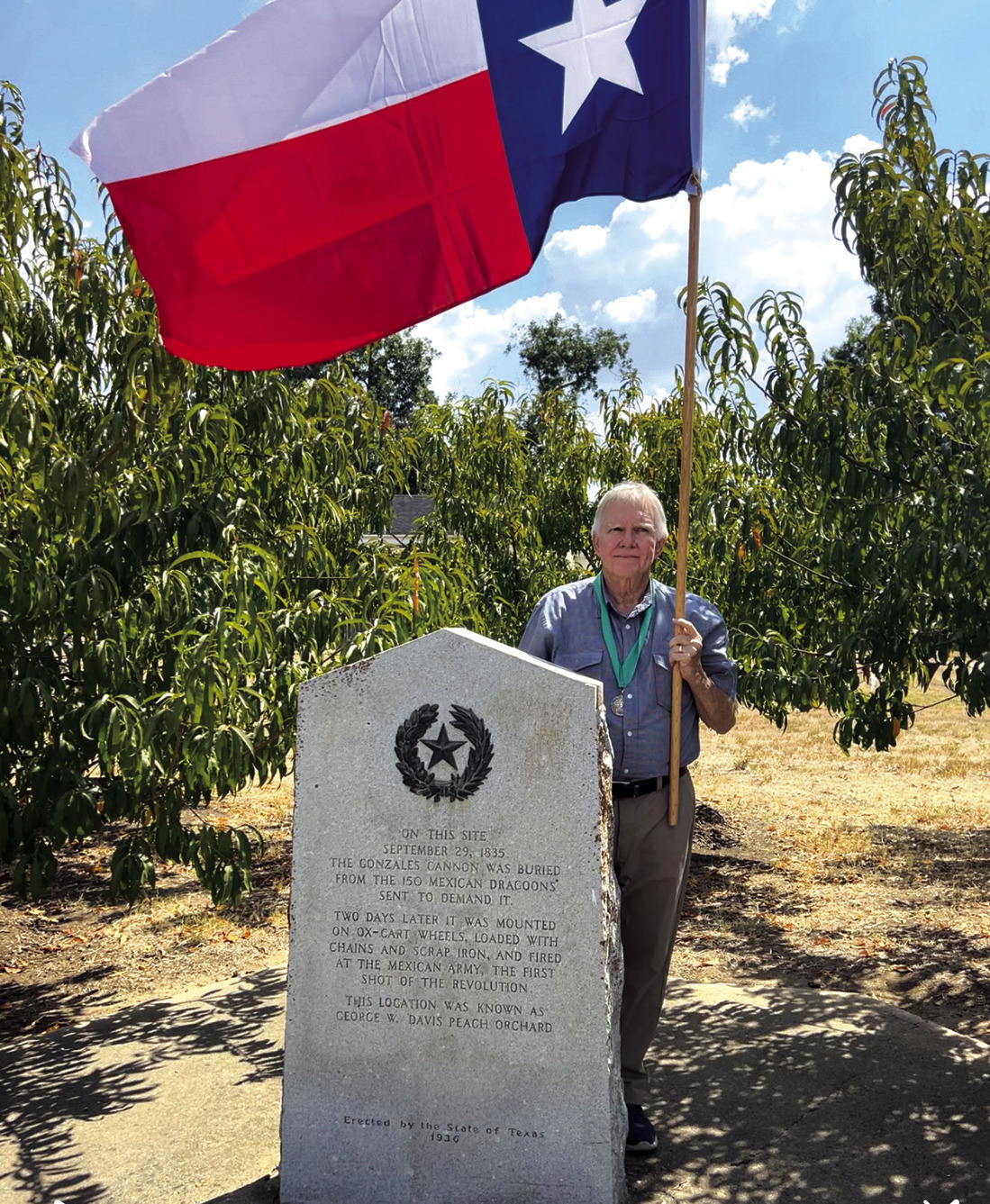
Gonzales cannon buried in Peach Orchard
In September 1835, Col. Domingo De Ugartechea, the military commander at Bexar, sent Corporal Casimiro De León and five soldiers of the Second Flying Company of San Carlos de Parras to retrieve the cannon. The Gonzales colonists notified Ugartechea they were keeping the cannon. To prevent any interference from the soldiers, they were taken prisoner. The cannon was then buried in the peach orchard owned by George W. Davis. Couriers were then sent to the settlements on the Colorado River and throughout sounding farms to obtain armed assistance.
On September 29, Capt. Robert M. Coleman arrived at Gonzales with a militia company of thirty mounted Indian fighters. The gun was retrieved from its shallow grave, taken to John Sowell's blacksmith shop, and mounted on the fore-wheels of Albert Martin’s cotton wagon before it was fired in the skirmish of the battle on October 2.
The name 'Come and Take It' refers to the motto adopted by the Texian rebels. A few days prior to the battle, a committee of five officers designed and hastily prepared a flag with an image of a cannon and the words “Come and Take It.” This flag was raised above the Gonzales cannon during the battle on October 2, and later carried with the gun toward San Antonio, but was soon lost without a trace. Materials for this flag were donated by the women of Gonzales. The women of the DeWitt family claim that the flag was made from the silk wedding dress of Naomi DeWitt Matthews.
It appears there were two cannons at the Battle of Gonzales, a much smaller iron gun called an esmeril, the smallest of Spanish cannons of the first class, of onepounder caliber or less.
Lt. Castaneda’s who was sent the second time to retrieve the cannon in his report of the battle, dated October 2nd and 4th, clearly indicate that two cannons were used in the battle. The esmeril was first loaded with chains and scrap iron then fired (October 2nd) in the second skirmish. Two other Mexican accounts mention both cannons in Gonzales. After the battle, Noah Smithwick needed to make repairs to the esmeril’s touch hole, and it was then mounted on a crude carriage made with sawn cross sections of a tree trunk. Both guns left Gonzales pulled by oxen with the Texian army headed for San Antonio.
Prior to the cannon leaving, Gen. Stephen F. Austin arrived at Gonzales; after the October 2nd battle, he organized the Texian 'Army of the People'. The cannon was assigned to Capt. James C. Neill's artillery company who was ordered to haul it to San Antonio as they followed the retreating Mexican troops. But the small gun’s carriage failed, and it was abandoned at Sandies Creek. (This is why there is some confusion about the cannon.) A major flood in 1936 uncovered the small gun leading to its rediscovery; it is now on display in the Gonzales Memorial Museum. The other larger cannon not fired in Gonzales was hauled to San Antonio and used during the Siege of Bexar.
After the Texans victory in the Siege of Bexar in December 1835, when the Mexican army pulled out of the Alamo and went back the Mexico, the cannon was placed in the Alamo where it remained with the Texas army until all the artillery pieces were commandeered by the Mexican army upon the recapture of the Alamo on March 6, 1836. This bronze Gonzales cannon was buried with other captured Texan cannons inside the Alamo compound after its fall.
(A bronze cannon dating to the Gutiérrez-Magee expedition was unearthed by Samuel Maverick in 1852, and sent to New York by his widow Mary Maverick in 1874, where it was recast into a bell that hangs in the belfry of St. Mark’s Episcopal Church in San Antonio. The cannon uncovered by Maverick is sometimes mistakenly identified as the 'Come and Take It' cannon.)